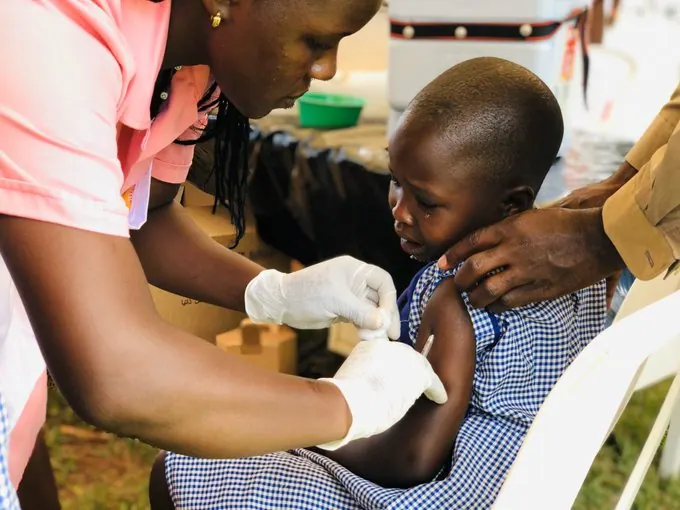
The Ugandan government is launching a nationwide measles-rubella vaccination campaign from October 1-5, 2026, targeting 7.47 million children aged nine to 59 months. The campaign aims to close immunity gaps and respond to a resurgence of measles across the country. According to the Ministry of Health, the campaign will provide free vaccination through various health facilities, temporary and mobile posts, schools, and community-based locations.
The campaign comes amid declining routine coverage of the second measles-rubella dose. National measles vaccination coverage rose from 79% in 2016 to 90% in 2024 but remains below the 95% level necessary to prevent outbreaks. The first MR dose is administered at nine months, while the second is given at 18 months. In 2025, coverage of the second dose stood at only 64%, compared with 92% for the first dose.
Measles outbreaks continue to affect districts across Uganda, with 66 districts recording confirmed measles outbreaks in 2025, resulting in over 10,163 cases and 60 deaths. Between January and April 2026, 20 districts reported confirmed outbreaks. The Ministry of Health attributes the outbreaks to low population immunity, inadequate uptake of the second MR dose, hard-to-reach populations, vaccine hesitancy, weak surveillance, and delayed health-seeking.
Dr. Michael Baganizi, a senior official in the Uganda National Expanded Programme on Immunisation, urged parents to have their children vaccinated, even if they had previously received an MR dose. The campaign is separate from routine immunisation, under which children receive MR vaccines at nine and 18 months. Baganizi emphasised that the purpose of this campaign is to boost immunity.
The Ministry of Health is conducting the campaign with support from Gavi, the Vaccine Alliance, the World Health Organisation, and UNICEF. The government and development partners have committed about Shs 20 billion to the vaccination campaign, with Gavi providing the largest share of the financing. However, Uganda's dependence on donor financing for immunisation has raised concerns.
Dr. Annet Kisakye, a WHO national professional officer, urged parents and caregivers to have their children vaccinated, citing the safety and effectiveness of the MR vaccine. She advised parents to remain at the vaccination point for about 30 minutes after their children are vaccinated to observe any immediate reactions.
The measles-rubella vaccine has been used safely for decades and remains a key tool in preventing measles and rubella. Measles is one of the most infectious diseases, causing fever, rash, cough, runny nose, and red eyes, with severe complications including pneumonia, diarrhoea, and neurological complications. The Ministry of Health aims to increase domestic financing for immunisation as donor financing changes.
Key points
- The Ugandan government targets 7.4 million children in a 5-day vaccination campaign to combat measles and rubella.
- The campaign aims to close immunity gaps and respond to a resurgence of measles across the country.
- The government and development partners have committed about Shs 20 billion to the vaccination campaign.