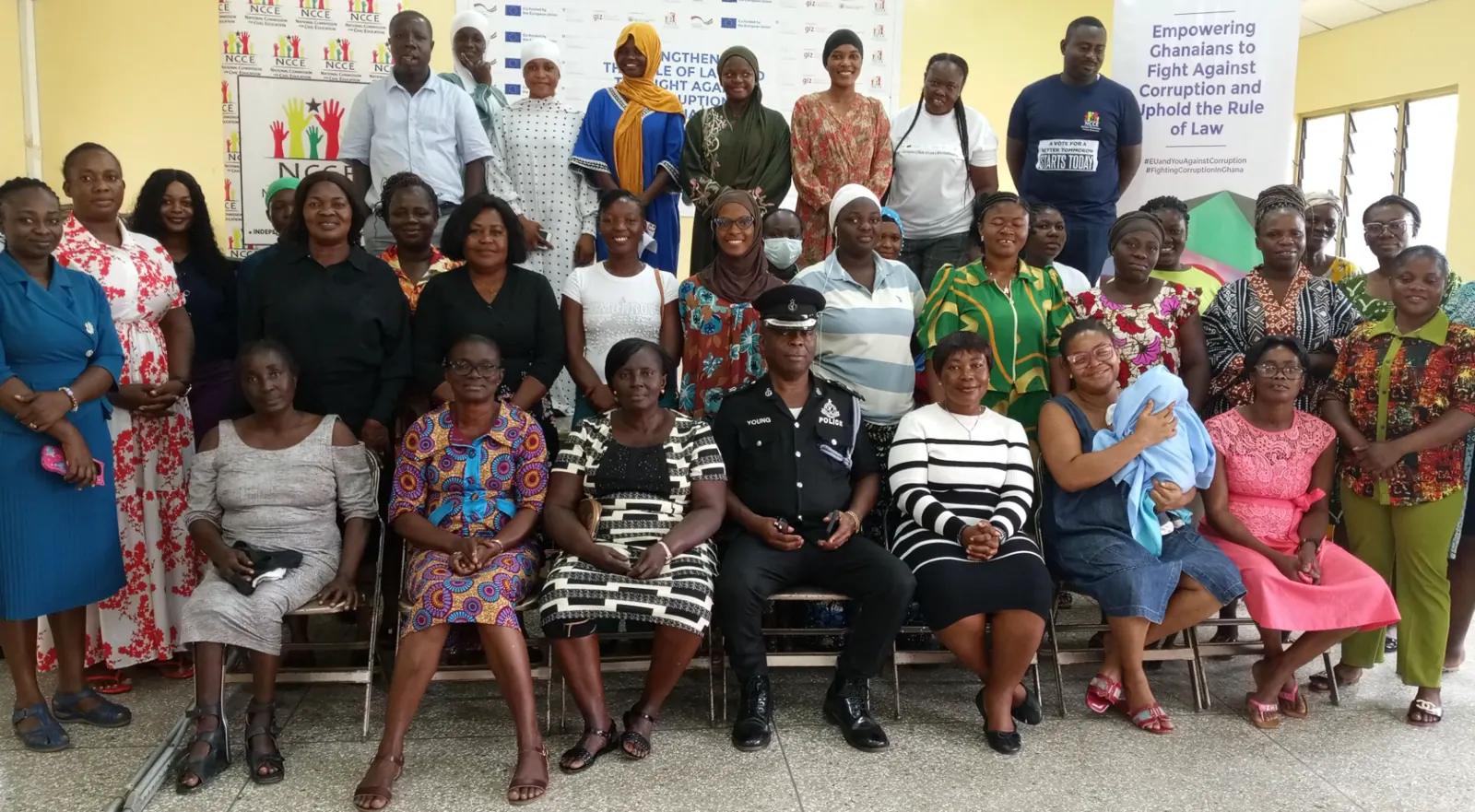
The New Juaben North Municipal Office of the National Commission for Civic Education (NCCE) in Ghana has held a follow-up capacity building engagement with women's groups on anti-corruption, the rule of law and accountability. The engagement, held at Effiduase, aimed to assess how participants had applied knowledge acquired during an earlier session and to reinforce positive attitudes and behaviours. The programme was organised under the Participation, Accountability and Integrity for a Resilient Democracy (PAIRED) programme.
The PAIRED programme was commissioned by the German Federal Ministry for Economic Cooperation and Development (BMZ) and co-financed by the European Union (EU) and the Swiss State Secretariat for Economic Affairs (SECO). It is implemented by the Deutsche Gesellschaft für Internationale Zusammenarbeit (GIZ) in cooperation with the Ministry of Finance. The engagement sought to empower women to become active champions of transparency, accountability and the rule of law in their families, workplaces and communities.
Ms Juliet Yeboah Simpey, New Juaben North Municipal Director of the NCCE, said the engagement was intended to clarify misconceptions and strengthen the participants' confidence to promote integrity and accountability. She emphasised the importance of women's involvement in promoting transparency and accountability. The engagement provided an opportunity for participants to share their experiences and challenges in promoting integrity and accountability.
Chief Superintendent Acolatse Young, New Juaben North Municipal Police Commander, addressed participants on corruption-related issues. He defined corruption as the dishonest use of authority or power for personal gain. He urged the participants to demand transparency, keep proper records, protect their businesses, and hold leaders accountable. Chief Supt Young also encouraged them to cooperate with lawful institutions and teach their children the values of integrity.
Mrs Hannah Morrison, New Juaben North Municipal Director of the Commission on Human Rights and Administrative Justice (CHRAJ), spoke on the topic "Building Community Integrity Through Women's Associations and Personal Collective Commitments to Promoting Transparency." She urged participants to uphold and strengthen their integrity, noting that weak integrity could create an environment for corruption to thrive.
Mrs Morrison noted that although some people attended church and listened to biblical teachings, they sometimes failed to practice them. She urged the public to be vigilant, recognise the various forms of corruption and reject practices that undermined integrity and transparency. The participants were encouraged to take an active role in promoting integrity and accountability in their communities.
Ms Helina Twum, a member of the Ghana Society of the Physically Disabled, said participating in the engagement for the second time had deepened her understanding of corruption-related issues. She said she would share the knowledge acquired with members of her group and encourage them to act diligently and uphold integrity. The engagement has equipped participants with the knowledge and skills to promote transparency and accountability.
Key points
- The NCCE engagement aimed to empower women to become active champions of transparency, accountability and the rule of law.
- The programme was organised under the Participation, Accountability and Integrity for a Resilient Democracy (PAIRED) programme.
- Participants were encouraged to promote integrity and accountability in their families, workplaces and communities.