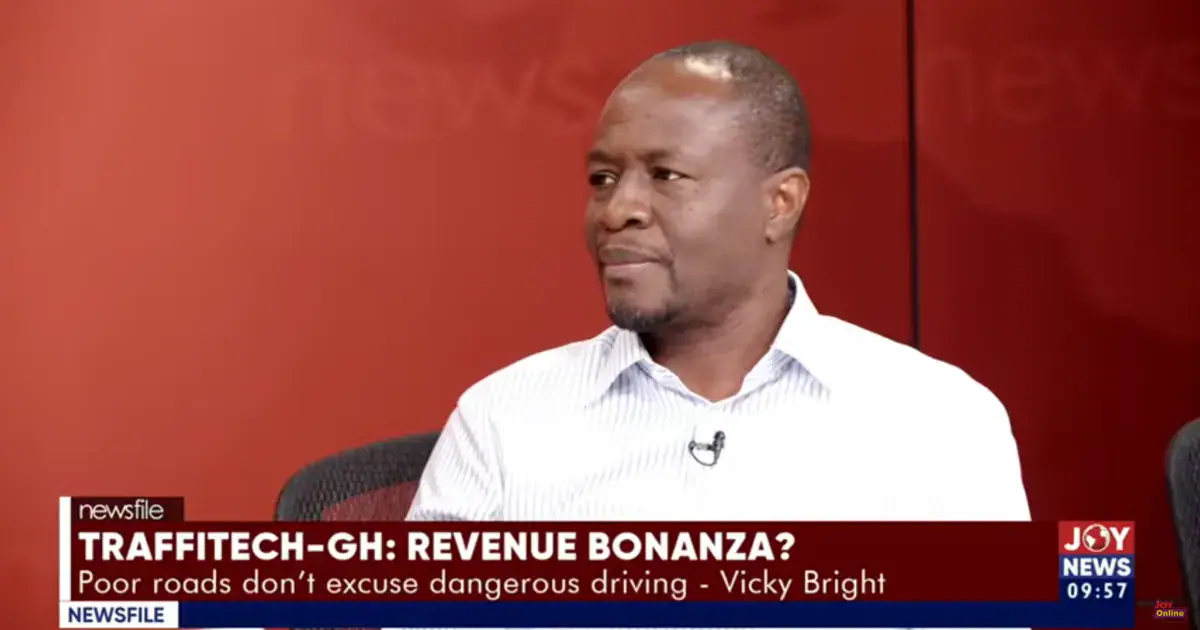
Former Head of Public Affairs at Ghana Cocoa Board, Fiifi Boafo, has expressed concerns over the government's intentions behind introducing the automated traffic enforcement system, Traffitech. He warned that the system must not become a revenue-generating tool for the government, rather than a road safety intervention. Boafo's comments come amid public discussions over Traffitech's enforcement mechanisms and financial arrangements. He emphasized that efforts to improve road safety are commendable, but the implementation of Traffitech must be transparent and guided by clear objectives.
Boafo questioned the government's true motivation for introducing Traffitech, citing the proposed arrangement where investors would receive 40% of penalties collected from motorists who violate traffic regulations, while the government receives 60%. He asked whether the government's share would be used to sustain the system or as another source of income. Boafo argued that revenue generated from penalties should be used to ensure the system's effective operation, rather than turning it into a revenue-generating venture. This, he believes, would undermine the intended road safety benefits of Traffitech.
Speaking on JoyNews' Newsfile, Boafo emphasized that the primary objective of Traffitech should be to punish traffic offenders, deter motorists from violating road regulations, and prevent accidents. He cautioned that Ghanaians are already overburdened and should not be subjected to an enforcement system that prioritizes raising money over preventing road traffic offences and accidents. Boafo urged authorities to clarify Traffitech's objectives and ensure that the system serves as a punitive measure to promote road safety.
The introduction of Traffitech has sparked public debate, with some welcoming the automated traffic enforcement system as a long-overdue measure to improve road safety. Others have raised concerns over its enforcement framework, warning of potential camera abuse and unlawful penalties. Bright Simons, a prominent figure, has questioned Traffitech's enforcement framework, while Sharif Khalid has warned that viewing enforcement as a revenue tool derails road safety efforts.
The Motor Traffic and Transport Department (MTTD) has addressed complaints over trade plates, vehicle ownership, and data under the new traffic system. ACP Alexander Obeng stated that the MTTD is working to resolve these issues. Meanwhile, Victoria Bright has welcomed Traffitech, saying it is long overdue. However, concerns over the system's potential impact on motorists and its effectiveness in improving road safety continue to be raised.
The Ghanaian government has begun implementing Traffitech, with motorists caught speeding above 130km/h in areas with a 50km/h limit. The system's enforcement has resulted in a 9.4% drop in road crashes and a 15% decrease in road crash injuries in September. The National Road Safety Authority (NRSA) has directed road agencies to fix faulty traffic lights and missing signs as Traffitech enforcement begins.
As Traffitech continues to be implemented, stakeholders are calling for transparency and clear objectives. The system's success will depend on its ability to balance road safety goals with the need to avoid overburdening motorists. With concerns over revenue generation and enforcement fairness, the government's handling of Traffitech will be closely watched.
Key points
- Fiifi Boafo warns that Traffitech must not become a revenue-generating tool for the government.
- The system's implementation must be transparent and guided by clear objectives.
- Traffitech's primary objective should be to promote road safety, not generate revenue.