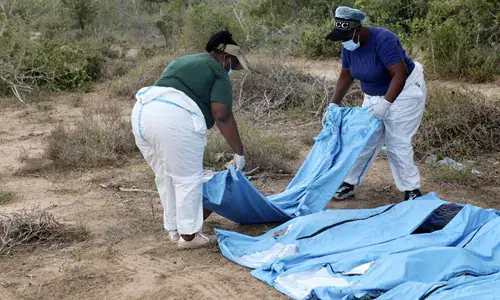
A Kenyan Senate committee has released a report criticizing the government's inaction on warnings about radical pastor Paul Mackenzie's activities, which led to the deaths of hundreds of his followers in a mass starvation incident in the Shakahola forest. The committee found that authorities had received numerous reports of missing persons, children being denied education, and families being torn apart, but failed to take decisive action. Mackenzie's activities had been monitored by police, judicial officials, and child protection agencies for seven years.
The committee's report, released on October 19, 2023, stated that there were ample opportunities to save lives, but government departments failed to connect the dots and take action. Mackenzie had been instructing his followers to abandon their jobs, reject medical treatment, and oppose certain government programs, such as the census and deworming campaigns. The Kilifi County Security Committee had summoned Mackenzie to explain his teachings and allegations of mistreating his followers, but authorities did not take further action.
Mackenzie had a history of run-ins with the law, including a 2017 arrest for operating an unregistered school at his Good News International Ministries church in Malindi. He was fined Sh20,000 and ordered to behave well. In October of the same year, he was charged with spreading radical ideology, operating an unregistered school, and denying children education, but was released in 2021 due to lack of evidence.
In 2019, the Kilifi County Consumer Committee discussed allegations that children were being brainwashed through Mackenzie's church and television station. The issue was escalated to the national committee and the Communications Authority, which revoked the station's license. However, the committee was not informed about the proposed deregistration of the church.
A significant warning sign was raised on March 6, 2022, when a report was filed at the Likoni Police Station about the disappearance of Sylvia Adoyo Mwende, who was believed to have been taken to Shakahola after visiting Mackenzie. A police officer investigating the case claimed to have obtained a burial permit with details suggesting that Mwende had died in Shakahola and was buried without her body being taken to the morgue.
In March 2023, Francis Wanje, searching for his missing grandchildren, obtained a court order to exhume two bodies believed to be buried in the forest. Police took five days to arrive at the scene after receiving the report, and Mackenzie's followers were found to have been subjected to starvation, torture, and death. The scale of the tragedy only became apparent in April 2023.
The Senate committee's findings have raised questions about the government's handling of the situation, with many Kenyans demanding accountability for the deaths of hundreds of people. Mackenzie's case has highlighted concerns about radicalization and the need for authorities to take proactive measures to prevent such incidents. The government has faced criticism for its inaction, with many calling for investigations into the handling of the situation.
Key points
- A Kenyan Senate committee report criticized authorities for failing to act on warnings about radical pastor Paul Mackenzie's activities.
- Mackenzie's followers died in a mass starvation incident in the Shakahola forest.
- Authorities had received numerous reports of missing persons and children being denied education but failed to take decisive action.
Reporting sources
- Mapuuza ya serikali kuhusu Mackenzie yaliyochangia mauaji Shakahola · taifaleo.nation.co.ke