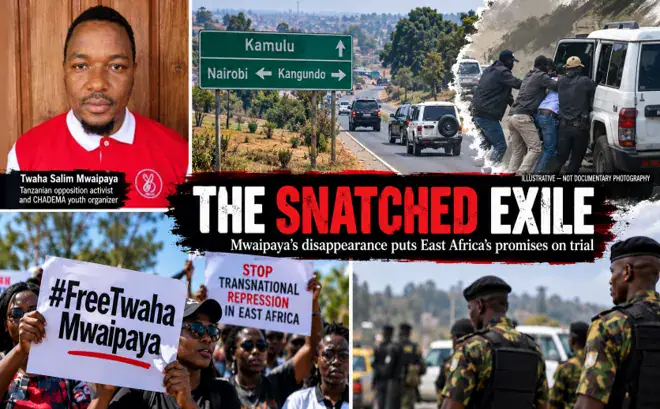
Twaha Salim Mwaipaya, a former national mobilisation coordinator for Chadema's youth wing, was reportedly abducted in Kamulu, Machakos County, on Sunday, 25 October 2026. According to Amnesty International Kenya, Mwaipaya was seized by people using three vehicles, including a Toyota Land Cruiser Hardtop, while travelling in a taxi to visit friends. The circumstances of his disappearance are still unclear, with his location, safety, and the identity of those responsible remaining unknown.
The reported abduction has raised concerns about transnational repression, with Mwaipaya's case echoing earlier incidents involving Tanzanian activists in Kenya. In January 2025, Maria Sarungi Tsehai, and in February 2026, human-rights defender Mshabaha Hamza, were also involved in similar cases. Furthermore, the disappearance of Ugandan opposition leader Kizza Besigye from Nairobi in November 2024 has intensified regional scrutiny. These cases have sparked concerns about the safety of people fleeing political pressure in East Africa.
Kenya's legal framework provides protection for refugees and asylum seekers, with Section 29 of the Refugees Act, 2021, setting out non-refoulement, restricting return, expulsion, or similar transfer where a person could face persecution for specified reasons, including political opinion. Additionally, Article II (3) of the 1969 OAU Convention Governing the Specific Aspects of Refugee Problems in Africa addresses rejection, return, and expulsion where a refugee's life, physical integrity, or liberty would be threatened.
Authorities in Kenya and Tanzania have been urged to investigate Mwaipaya's disappearance and ensure his safety. The Tanzania Human Rights Defenders Coalition has called for an immediate investigation, while Amnesty International Kenya has demanded that Mwaipaya's whereabouts be established and an impartial investigation into possible official involvement be conducted. The Kenyan and Tanzanian governments have not publicly commented on the incident, with the exception of Tanzania's High Commissioner to Kenya, Bernard Kibesse, stating that the embassy was following up on the matter.
The incident has sparked concerns about the effectiveness of protection for people fleeing political pressure in East Africa. Governments in the region have been accused of using transnational repression to intimidate, surveil, threaten, or silence critics beyond their borders. Investigators should examine witness accounts, CCTV and traffic-camera footage, vehicle movements, and relevant border or detention records to establish the circumstances of Mwaipaya's disappearance.
Mwaipaya's family, lawyers, and colleagues should be approached safely for information about his last known movements, previous threats, and efforts to trace him. Their accounts should be used with informed consent and care for their safety. The case has also raised questions about the role of digital surveillance in Mwaipaya's disappearance, with telecommunications evidence being obtained lawfully and preserved promptly.
The international community is watching closely as East Africa's governments are put to the test on their commitment to protecting human rights and the rule of law. The outcome of the investigation into Mwaipaya's disappearance will be crucial in determining the effectiveness of protection for people fleeing political pressure in the region.
Key points
- 1. The reported abduction of Twaha Salim Mwaipaya raises concerns about transnational repression in East Africa. 2. Kenya's legal framework provides protection for refugees and asylum seekers, but its effectiveness is being tested in Mwaipaya's case. 3. Authorities in Kenya and Tanzania have been urged to investigate Mwaipaya's disappearance and ensure his safety.