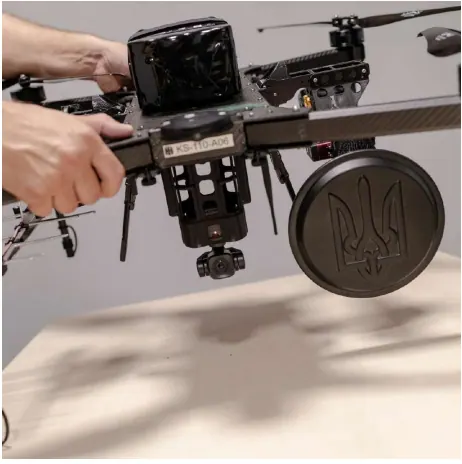
The ongoing conflict between Russia and Ukraine has accelerated the development and deployment of semi-autonomous and fully autonomous drones. Both nations have prioritized the use and production of drones since the war began in February 2022. Russia initially turned to Tehran for technological assistance, while Ukraine leveraged its nascent drone industry and private defense firms to drive innovation. This rapid advancement has raised concerns about the potential for a battlefield dominated by fully autonomous drones.
Ukraine and Russia have deployed drones with autonomous functions using AI to recognize targets, navigate, and self-guide to targets. In November 2025, a Ukrainian first-person-view drone utilized an AI-assisted guidance system to strike a probable Russian tank after its communications link with the operator was disrupted. Although reliable estimates of the numbers of these drones on the battlefield are unavailable, reports suggest they represent only a small percentage of the millions of drones deployed to date.
Russia reportedly fielded a fully autonomous unmanned aerial vehicle in early 2025, with Ukrainian analysis of recovered Russian V2U drones revealing a small Nvidia computer designed to run AI-enabled decision-making software. Variants recovered in late 2025 no longer contained external communications systems, suggesting a reduced need for operator control. The V2U's technical systems enable autonomous selection and engagement of targets without operator intervention following launch.
The onboard AI in the V2U drone utilizes computer vision, allowing it to analyze images from its onboard sensors, autonomously recognize objects, track them, navigate, and select potential targets. In July, Russia employed a different AI-enabled drone in combat, demonstrating a less comprehensive form of autonomous targeting. The strike, on a gas station in Zaporizhzhia, resulted in the deaths of three Ukrainian civilians.
Ukraine has focused on modular AI-driven packages that can be installed widely across drones and other platforms. One such module tracks targets and guides the drone in the final 500 meters to them. Former Defence Minister Mykhailo Fedorov stated that Ukraine used a drone that autonomously chooses targets with no radio connection to a human pilot in strikes in Russian-occupied Crimea. Ukraine also reportedly employed fully autonomous quadcopter drones against Russian forces near Bakhmut.
The deployment of drones with autonomous capabilities has had a significant battlefield impact, despite Kyiv and Moscow not yet deploying the most advanced systems in large numbers. These drones reduce their dependence on communications links and can continue to operate despite jamming and other forms of electronic warfare. However, concerns arise regarding the potential for autonomous drones to outpace human control, raising questions about the ability to maintain some type of human oversight.
Ukrainian Ministry of Defense rules require keeping humans in the loop for "combat" decisions, while Russia's arms control positions emphasize "human control" with a focus on the ability to alter the system, deactivate it, or provide limitations. The development and employment of autonomous drone technology have sparked concerns about the potential risks and consequences of deploying fully autonomous drones at scale.
Key points
- Russia and Ukraine are rapidly advancing autonomous drone technology, with both nations deploying drones with autonomous functions using AI.
- The development and employment of autonomous drone technology risk outpacing human control, raising concerns about the potential consequences.
- The deployment of fully autonomous drones at scale could reduce the personnel required to operate large numbers, but also raises serious ethical concerns.