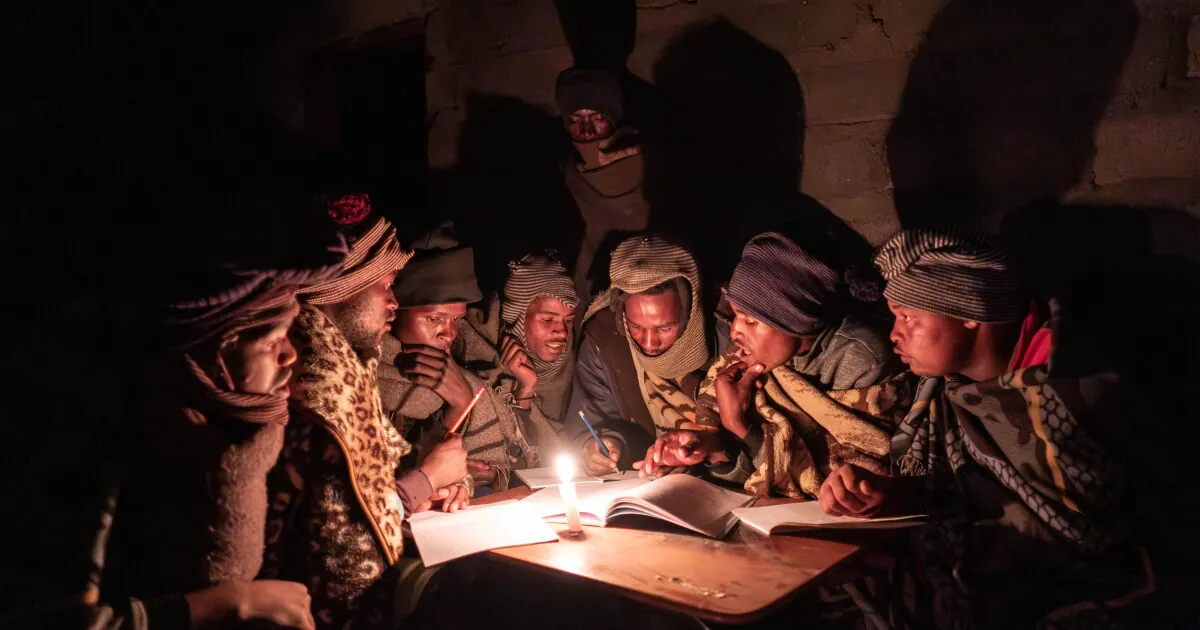
In the mountainous country of Lesotho, a unique school is providing a second chance at education for young herders. The Good Shepherd School, located in the small town of Semonkong, offers night classes for over 40 herders who have had to drop out of school to tend to their family's flocks. Every evening, dozens of young men, wrapped in wool blankets, make their way down the mountainsides, singing and chatting excitedly as they approach the school.
Lesotho's economy and culture are deeply rooted in livestock, with wool and mohair accounting for nearly 60% of agricultural exports and supporting a quarter of the rural population. However, this has led to many school-aged boys being called to tend to the flocks, often at the expense of their education. A World Bank analysis of 2018 data found that nearly half of all boys in the country were engaged in some form of herding. For many, like 20-year-old Kabelo Mohai, the work comes at the expense of schooling.
Mohai, who started working with animals at the age of 9, only finished primary school. He now attends the Good Shepherd School, where he is studying for his Grade 7 certificate. The school, founded in 2003, is run by the Good Shepherd Sisters of Quebec congregation and offers classes for students ranging in age from 15 to 55. The school's teacher, Sister Rosemary Mokebe, says that the herders are very important to the country's economy and that without the school, they would be "sitting in the dark" without the ability to read or write.
The night school is one of many similar schools that have emerged across the country, mostly run by volunteers on shoestring budgets. These schools offer basic education, including reading, writing, and counting, and provide a chance for herders to dream of a different future. For Mohai, attending the school has given him hope that he might eventually find employment outside herding. He dreams of becoming a soldier and says that he attends school to keep his ability to read and write.
The Lesotho government estimates that there are about 155 such schools nationwide, which were originally supported by various nongovernmental groups. However, in recent years, the Ministry of Education has slowly taken over, seeking to formalize the volunteer-run classes and provide stipends to rural educators. Despite this, the process has been hampered by delays and bureaucratic hurdles, with educators' annual contracts yet to be renewed.
For some students, like 40-year-old Motlatsi Monoana, attending the night school has been a life-changing experience. Monoana had never been to school until this year, and his inability to read and count had put him at a disadvantage. He says that he is regularly cheated by employers and cannot read the contracts he signs. The night school has given him hope that he might eventually find employment outside herding.
As the night school continues to provide education to herders, it faces financial struggles and uncertainty about its future. However, for students like Mohai and Monoana, the school has already made a significant impact. The school's dedication to providing education to those who need it most is a testament to the power of education to change lives.
Key points
- The Good Shepherd School in Lesotho provides night classes for over 40 herders who have had to drop out of school to tend to their family's flocks.