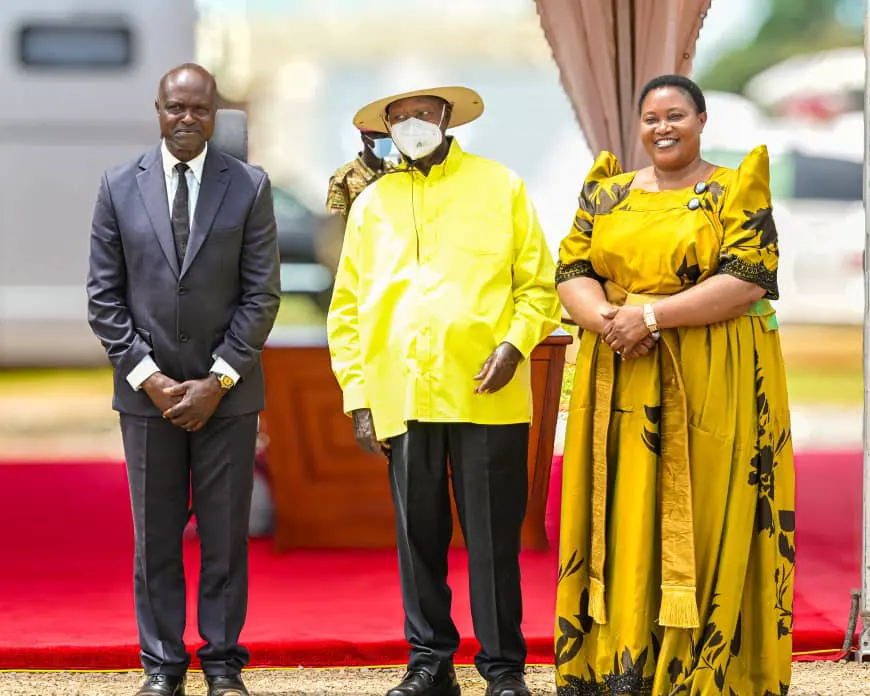
President Yoweri Kaguta Museveni has urged the people of Busoga to adopt wealth-creation programmes and productive forms of agriculture suited to their landholdings to overcome household poverty. He made the call at the thanksgiving ceremony of Minister for the Presidency and Budiope West Member of Parliament, Hon. Babirye Milly Babalanda, in Buyende District. President Museveni emphasized the need for residents to make proper use of Parish Development Model (PDM) funds to generate sustainable household incomes.
President Museveni noted that land fragmentation remains a major challenge affecting household incomes in Busoga, with successive generations inheriting increasingly smaller portions of land. He said the NRM Government has promoted approaches like the Four-Acre Model to help households maximize income from limited land through productive enterprises. The President encouraged farmers to select enterprises according to their land size, citing dairy farming, poultry, and fish farming as examples of enterprises that can generate substantial incomes from small areas.
President Museveni cited examples of successful farmers in Uganda, including George Matongo from Ngoma-Nakaseke District, who produces 900 liters of milk daily and earns over Shs21 million per month. He also mentioned Johnson Basangwa from Kamuli, who operates a poultry enterprise on a small piece of land and earns about Shs20 million per day. The President emphasized that residents can succeed in various enterprises as long as they are done with calculation and a focus on wealth creation.
The President urged residents to explore economic opportunities associated with wetlands and natural resources within the law, including fish farming at the edges of wetlands. He said fish farming can generate significant income from small pieces of land, citing an example of two fish ponds on one acre potentially generating up to Shs140 million. President Museveni cautioned residents against relying excessively on sugarcane, rice, and tobacco growing on small pieces of land, where returns may not be sufficient to transform household incomes.
President Museveni reminded Ugandans that the Government has identified four broad sectors for wealth creation and economic transformation: commercial agriculture, services, ICT, and manufacturing. He encouraged Ugandans to identify opportunities within these sectors according to their circumstances and available resources. The President also explained that minerals and water bodies are national resources regulated by the Government, while communities living near such resources can benefit within the established legal and regulatory framework.
At the same event, President Museveni elevated Ms. Sarah Kasadha from Deputy Resident District Commissioner (DRDC) to full RDC. The Third Deputy Prime Minister and Minister without Portfolio, Rt. Hon. Rukia Isanga Nakadama, thanked President Museveni for the Parish Development Model, saying it is helping young people and Ugandans engage in income-generating activities and work their way out of poverty. Minister Babalanda commended the President for the development taking place in Buyende District, including improvements in the road network and the new ferry.
Other leaders who spoke at the event, including Hon. Sarah Namulondo, Pastor Jimmy Kajura, and Hajji Abubakar Walubi, commended President Museveni for promoting wealth creation and thanked him for his efforts against corruption and for providing security during the recent elections. They also raised concerns over the planned nuclear project in Bukungu and called for additional interventions tailored to the region's circumstances, such as community-based irrigation projects.
Key points
- President Museveni urges Busoga residents to adopt wealth-creation programmes and productive agriculture to overcome household poverty.
- The President promotes the Four-Acre Model as a way for households to maximize income from limited land through productive enterprises.
- President Museveni identifies four broad sectors for wealth creation and economic transformation: commercial agriculture, services, ICT, and manufacturing.