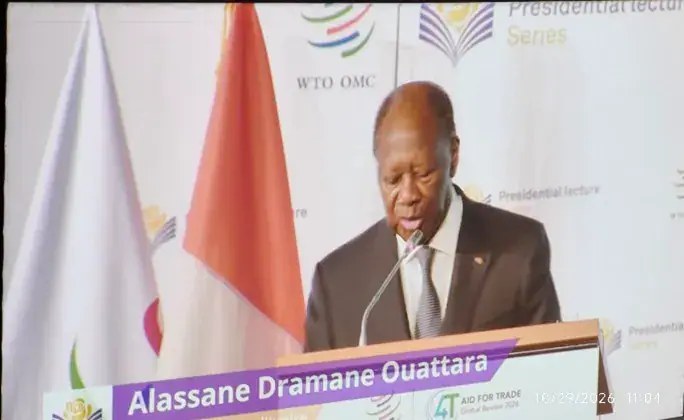
President Allassane Ouattara of Côte d'Ivoire has underscored the significance of international trade as a powerful driver of growth, expanding markets, and integrating economies into global value chains. He made these remarks at the presidential lecture of the 20th anniversary of the Aid for Trade programme, held at the World Trade Organization (WTO) headquarters in Geneva, Switzerland. The event also marked the 10th Global Review of Aid for Trade.
The Aid for Trade initiative was launched in 2005 to help developing economies benefit from market access opportunities offered by the multilateral trading system. President Ouattara highlighted that investment contributes to infrastructure development, modernization of productive systems, innovation, and the creation of sustainable jobs. He emphasized that these two pillars can accelerate a country's development trajectory.
However, President Ouattara noted that the benefits of trade and investment are neither automatic nor evenly distributed. He warned that an economy that mainly exports raw materials while importing high-value-added manufactured goods risks remaining trapped in a position of dependency. To maximize the benefits of trade and investment, President Ouattara stressed the need to align trade and investment policies with industrial, agricultural, and technological strategies.
President Ouattara's vision for Côte d'Ivoire is to move beyond its traditional specialization in primary commodity exports and secure a greater role in innovation, processing, manufacturing, and marketing activities. He emphasized that this requires improving infrastructure, developing skills, facilitating access to finance, and promoting technology transfer. Coherent public policies, strengthened international cooperation, and trade rules that enable vulnerable countries to seize global economic opportunities are also essential.
Côte d'Ivoire has made significant progress in recent years, recording sustained economic growth averaging approximately 7 per cent between 2012 and 2025. This performance exceeded the average for sub-Saharan Africa and the global economy over the same period. The country has also experienced significant growth in trade, gradual market diversification, and strengthened productive capacity.
In the cocoa sector, President Ouattara reported significant progress, with the processing rate for the 2024-2025 season estimated at 41 per cent. The country aims to increase processing of cocoa and other commodities within its borders, retaining a larger share of value added, creating jobs, particularly for young people, and diversifying its economy.
President Ouattara concluded that re-globalization should allow countries to move from an integration model based primarily on the export of raw materials to one founded on value creation, competitiveness, and productive transformation. This transformation can enable countries to participate more meaningfully in international trade and derive greater value from it.
Key points
- President Ouattara emphasizes the need to align trade and investment policies with industrial, agricultural, and technological strategies.
- Côte d'Ivoire aims to increase processing of cocoa and other commodities to retain a larger share of value added and create jobs.
- The country's economic growth averaged approximately 7 per cent between 2012 and 2025, exceeding the average for sub-Saharan Africa and the global economy.