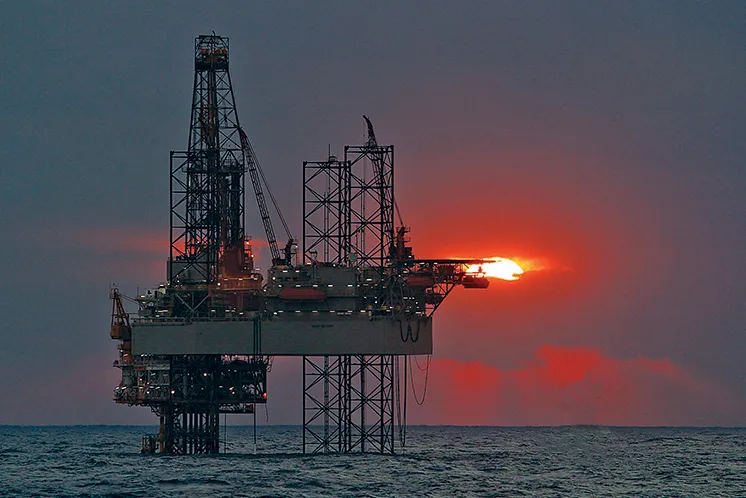
The discovery of oil in offshore Namibia has led to a significant influx of foreign capital, with the oil and gas industry attracting N$74.4 billion in foreign direct investment between 2021 and 2025. This accounts for roughly 56% of total inflows, according to Emma Haiyambo, research director at the Bank of Namibia. The substantial investment has been a major boost to the country's economy.
The oil and gas industry has also made a notable contribution to Namibia's gross fixed capital formation, accounting for 30% of the new value added to the economy through fixed infrastructure or machinery. However, Haiyambo noted that the industry's contribution to the country's gross domestic product has been relatively low. This is due to the fact that not all investment from oil exploration is spent within Namibia.
The discovery of oil has led to an increase in imports related to the industry, with most of these imports being services. According to Haiyambo, the industry accounts for over a third of all imports in services to the country, but only 1% of goods imported. This highlights the domestic economy's capacity constraints in meeting the demands of the oil and gas industry.
Bank of Namibia governor Ebson Uanguta emphasized the need for Namibia to prepare to utilize oil and gas to drive economic growth. He questioned how the country can ensure that the oil and gas industry strengthens a diversified and resilient economy, rather than deepening dependence on another primary commodity. The governor also highlighted the potential effects on local participation, jobs, and the environment.
Uanguta further noted that the oil and gas industry will bring new financial considerations, including effects on inflation and the financial system. The bank anticipates that large financial flows and exports could have significant effects on inflation, which is its core mandate. The financial sector will also be exposed to larger capital projects, which brings its own risks.
The governor raised concerns about whether Namibia's policies, institutions, regulatory frameworks, human capital, and economic structures are ready for the transition from exploration to production. As the country moves forward, it is essential to address these questions to ensure that the oil and gas industry benefits the economy as a whole.
Looking ahead, Haiyambo expects the import of goods to increase as operators prepare for production. This is likely to have a positive impact on the domestic economy, but it also requires careful planning and management to mitigate potential risks. The oil and gas industry presents both opportunities and challenges for Namibia, and it remains to be seen how the country will navigate this new reality.
Key points
- The oil and gas industry has attracted N$74.4 billion in foreign direct investment since 2021.
- The industry accounts for 30% of gross fixed capital formation and over a third of all imports in services.
- The Bank of Namibia governor emphasized the need for careful planning to ensure the oil and gas industry benefits the economy.