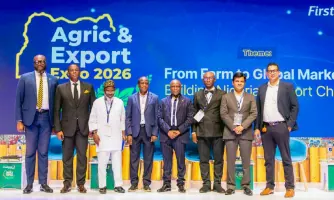
Nigeria's agricultural potential has long been recognised, but stakeholders are increasingly calling for a shift from simply producing more food to building a complete value chain capable of feeding the nation, creating jobs, supporting industries, and competing in global markets. This urgency was underscored at the fifth edition of the FirstBank Agric & Export Expo 2026, where government officials, financial institutions, and international stakeholders highlighted the need for stronger collaboration across production, processing, financing, research, infrastructure, and market access.
The Expo, themed “From Farm to Global Markets: Building Nigeria’s Export Value Chain,” brought together producers, processors, exporters, financiers, policymakers, and investors to explore ways of unlocking opportunities in agriculture and non-oil exports. With more than 2,000 participants and 100 exhibitors at the 2026 edition, the event provided a platform for technical sessions, business matchmaking, exhibitions, and networking. The discussions went beyond the traditional emphasis on increasing farm output, highlighting the need to ensure that agricultural production translates into economic value.
Olusegun Alebiosu, the Chief Executive Officer of FirstBank Group, said the bank was deliberately shifting the focus of the Expo from conversations to execution. He said agriculture and exports remained critical to Nigeria’s economic diversification agenda and held tremendous potential for strengthening sustainable economic growth. Alebiosu noted that the objective of bringing stakeholders together was to create practical opportunities that could transform ideas into enterprises.
Lucky Aiyedatiwa, the Ondo State Governor, emphasized the need for deliberate collaboration among farmers, the private sector, financial institutions, and development partners. He said farmers could provide production, while the private sector could bring capital, technology, and marketing. Financial institutions, he added, could develop appropriate financing instruments to support farmers across different categories. Aiyedatiwa also linked agricultural development with some of the country’s wider challenges, including insecurity.
Ronaldo Vieira, Consul General of Brazil in Lagos State, shared Brazil's experience in building a successful agricultural sector. He said Brazil’s agricultural success did not happen overnight but was built over about 200 years following the country’s independence in 1822. Vieira described Brazil’s agricultural value chain as the product of an integrated system involving government, the private sector, research institutions, finance, production, and skills development.
Vieira highlighted the importance of research, finance, and family farming in Brazil's agricultural model. He cited the Brazilian Agricultural Research Corporation, Embrapa, which has more than 2,000 researchers and more than 75 schools, with up to 10,000 people working on the development of agricultural technologies. Vieira also stressed that Brazil’s financing system supported not only large-scale agribusiness but also family farming.
Governor Babajide Sanwo-Olu of Lagos State, represented by Abisola Olusanya, the Commissioner for Agriculture and Food Systems, stressed the need to view agriculture beyond its traditional role of feeding the population. He said the continued relevance of the FirstBank Agric & Export Expo was evidence of growing recognition that agriculture could serve as an engine of economic growth, industrialisation, job creation, and export earnings.
Key points
- Nigeria needs to build an integrated agricultural value chain to compete in global markets.
- Collaboration among farmers, private sector, financial institutions, and development partners is crucial for agricultural development.
- Brazil's agricultural success is attributed to its integrated system involving government, private sector, research institutions, finance, production, and skills development.