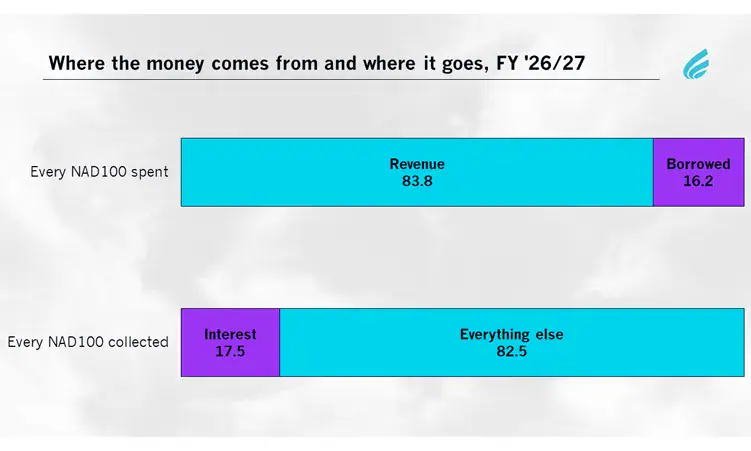
The Namibian government has released its mid-year budget review, which projects a lower growth rate of 2.3% for 2026, down from 3.1% in February. The review cites a decline in diamond output, which is forecast to fall by more than a fifth this year, as a major contributor to the downgrade. The government's revenue projections have also been revised down by N$1.5 billion to N$88.1 billion, representing only 0.8% growth over the previous year.
The mining sector is expected to account for much of the weakness in revenue, with diamond taxes and royalties projected to bring in N$414 million this year, down from N$5.8 billion in the 2023/24 financial year. In contrast, total spending has been cut by N$988 million to N$105.0 billion, mainly due to lower interest estimates and slower loan-funded projects. The government's development spending on roads, rail, and other infrastructure has fallen to N$6.7 billion, its lowest share since the 1990/91 financial year.
The review also highlights the government's borrowing plans, with a deficit of N$16.3 billion, or 5.5% of gross domestic product (GDP), and government debt revised up by N$7.9 billion to N$201.7 billion, or 68.7% of GDP. The primary balance, which excludes interest, has moved from a planned N$438 million surplus to a N$881 million deficit. The government has raised about N$19.7 billion so far this year, partly through new longer-dated bonds with coupons of 9.00% to 11.00%.
Economists have expressed concerns that the review's projections do not reflect conditions on the ground, with tax revenue trimmed by only N$86 million despite the growth downgrade. The ministry's 2.3% growth forecast is also above some economists' estimates, who expect growth to be lower. The review sets aside N$179 million to contain foot-and-mouth disease, almost the same as the N$180 million allocated to the Presidency for sport facilities and security.
The government's interest bill is expected to be lower than previously projected, with a reduction of N$800 million this year and further cuts in the next two years. However, this does not match the government's borrowing costs in the market, which have averaged around 9.8% recently. Investors now demand 1.50 percentage points more to hold Namibian rather than South African bonds, up from 0.94 a year ago.
The review assumes that the oil shock, foot-and-mouth disease, and El Niño are temporary and that the oil sector will eventually close the gap. However, some economists argue that the interest bill is likely to be revised higher in the February 2027 budget, given the current borrowing costs. If the average cost of domestic debt stayed at its current 8.2%, interest would be about N$4.7 billion higher over the next three years.
The mid-year budget review has implications for the country's fiscal policy and debt management. The government will need to balance its spending plans with the need to manage its debt and interest bill. The review's projections will be closely watched by investors and economists, who are keen to see how the government plans to address the challenges facing the economy.
Key points
- The Namibian government's mid-year budget review projects a lower growth rate of 2.3% for 2026.
- The review cites a decline in diamond output and mining revenue as major contributors to the downgrade.
- The government's debt has been revised up by N$7.9 billion to N$201.7 billion, or 68.7% of GDP.