The launch of Namibia's first state-owned air ambulance service marks a significant step towards addressing the country's healthcare challenges. In a country where geography can be a major obstacle, the ability to transport critically ill patients by air is a welcome development. The service aims to provide emergency medical care to those in need, particularly in rural and isolated communities. The air ambulance service is expected to make a positive impact on the country's healthcare system.
Health Minister Esperance Luvindao clarified that the service will not evacuate every patient, as aeromedical transportation is a specialized and costly intervention that must be reserved for circumstances where the patient's clinical condition warrants it. Patients requiring urgent neurosurgical, cardiac, trauma, and obstetric interventions, as well as those needing specialized medical monitoring during transportation, are among those who could benefit from the service. The prioritization of patients is both medically responsible and fiscally necessary.
The criteria governing access to the air ambulance service must be transparent, consistently applied, and understood by hospitals, medical personnel, and the public. An emergency call centre has been activated to coordinate referrals and dispatch services, which must operate efficiently to avoid bureaucratic obstacles between critically ill patients and potentially life-saving assistance. The call centre will play a crucial role in ensuring that the service is accessible to those who need it.
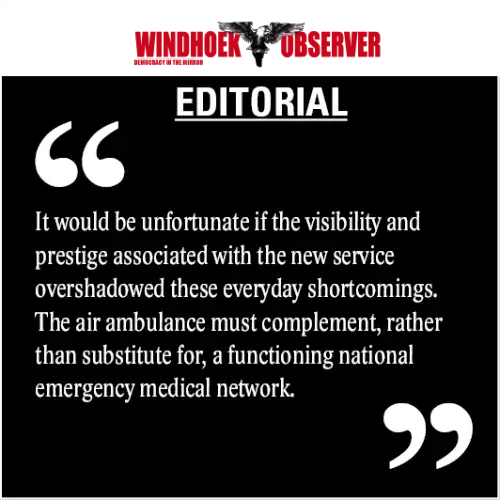
The air ambulance service cannot compensate for weaknesses in the country's ordinary emergency medical services. Many Namibians, particularly those in rural communities, face challenges in accessing basic emergency assistance, including functioning road ambulances, adequate medical equipment, and sufficiently staffed health facilities. The government must confront these broader issues to ensure that the air ambulance service is effective in the long term.
The Ministry of Health has announced plans to establish a dedicated directorate for emergency services, which will be crucial in integrating the air ambulance service with the country's overall emergency medical network. The involvement of the Namibian Police Force, the Namibia Defence Force, and Government Air Transport Services is encouraging, as it demonstrates that government institutions can pool resources and expertise towards a common national objective.
The operation of the air ambulance service will require substantial investment in maintenance, fuel, specialized medical equipment, personnel, and training. The government must demonstrate that it has developed a sustainable funding model capable of keeping the service operational over the long term. The Namibia Civil Aviation Authority must also maintain rigorous safety oversight to ensure the service operates safely and effectively.
The success of the air ambulance service will be measured by lives saved, response times improved, and patients successfully transferred to facilities capable of treating them. The government deserves credit for recognizing the importance of aeromedical emergency services and taking steps to establish them. However, the larger responsibility is to strengthen the entire emergency healthcare system, including the less visible but equally essential network of ground ambulances and adequately equipped hospitals.
Key points
- The air ambulance service will prioritize patients requiring urgent neurosurgical, cardiac, trauma, and obstetric interventions.
- The government must develop a sustainable funding model to keep the service operational over the long term.
- The success of the service will be measured by lives saved, response times improved, and patients successfully transferred to facilities capable of treating them.