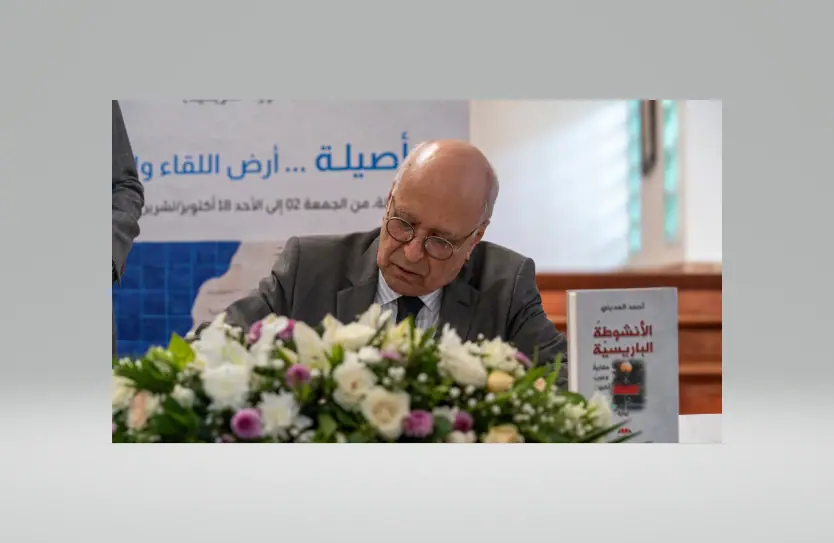
Moroccan writer Ahmed Medini's latest novel, "Al-Anshouta Al-Barisiyah" (The Parisian Knot), has been garnering attention for its thought-provoking exploration of the cultural divide between East and West. Published in 2026 by the Cultural Center for Books, the novel is a culmination of Medini's years of writing about his experiences in Paris. Medini's works have long been characterized by his fascination with the city, which he has explored in various forms, including travelogues, essays, and short stories. His writing often reflects his own experiences as a Moroccan living in France.
The novel follows the story of its protagonist, Basim Munir Serhan, a Moroccan journalist who leaves his mundane life in Rabat to start anew in Paris. Serhan's journey is marked by his encounters with various Moroccan and Arab expatriates, each with their own unique stories and struggles. Through Serhan's experiences, Medini masterfully weaves a narrative that not only explores the complexities of cultural identity but also sheds light on the intricacies of Parisian life. The city's topography and history are meticulously recreated, immersing readers in the world of 1980s Paris.
One of the central figures in the novel is Muhammad al-Bahi, a prominent Moroccan journalist and intellectual who becomes a mentor to Serhan. Al-Bahi's character serves as a linchpin, holding together the novel's narrative threads. His story, which spans from his childhood in the Sahara to his later years as a prominent figure in Parisian intellectual circles, is a testament to the complexities of the human experience. Through al-Bahi's character, Medini explores themes of identity, belonging, and the search for meaning.
Medini's Paris is a city of contrasts, where the grandeur of the Eiffel Tower and the Louvre Museum coexist with the humbler realities of immigrant life. The novel's vivid descriptions of Parisian neighborhoods, cafes, and streets transport readers to a bygone era, one marked by the Cold War and the rise of globalization. Medini's writing is characterized by its lyricism and attention to detail, making Paris a character in its own right.
The novel also explores the experiences of other Moroccan and Arab expatriates, each with their own unique stories and struggles. From the literary salons of Paris to the city's underground music scene, Medini's novel offers a nuanced portrayal of expatriate life. His characters are multidimensional and relatable, their struggles and triumphs evoking a range of emotions in the reader.
Throughout the novel, Medini grapples with the complexities of cultural identity and the East-West divide. His exploration of these themes is both thought-provoking and deeply human. As Serhan navigates the complexities of Parisian life, he is forced to confront his own identity and sense of belonging. The novel raises important questions about the nature of identity and culture, encouraging readers to reflect on their own place in the world.
Medini's latest novel is a significant contribution to contemporary Arabic literature. His exploration of the human experience, marked by its complexity and nuance, is a testament to the power of literature to bridge cultural divides. "Al-Anshouta Al-Barisiyah" is a rich and immersive novel that will appeal to readers interested in literary fiction, cultural studies, and the complexities of the human experience.
Key points
- The novel explores the complexities of cultural identity and the East-West divide through the lens of Paris.
- The protagonist, Basim Munir Serhan, navigates the complexities of Parisian life, confronting his own identity and sense of belonging.
- The novel offers a nuanced portrayal of expatriate life, exploring the experiences of Moroccan and Arab immigrants in Paris.