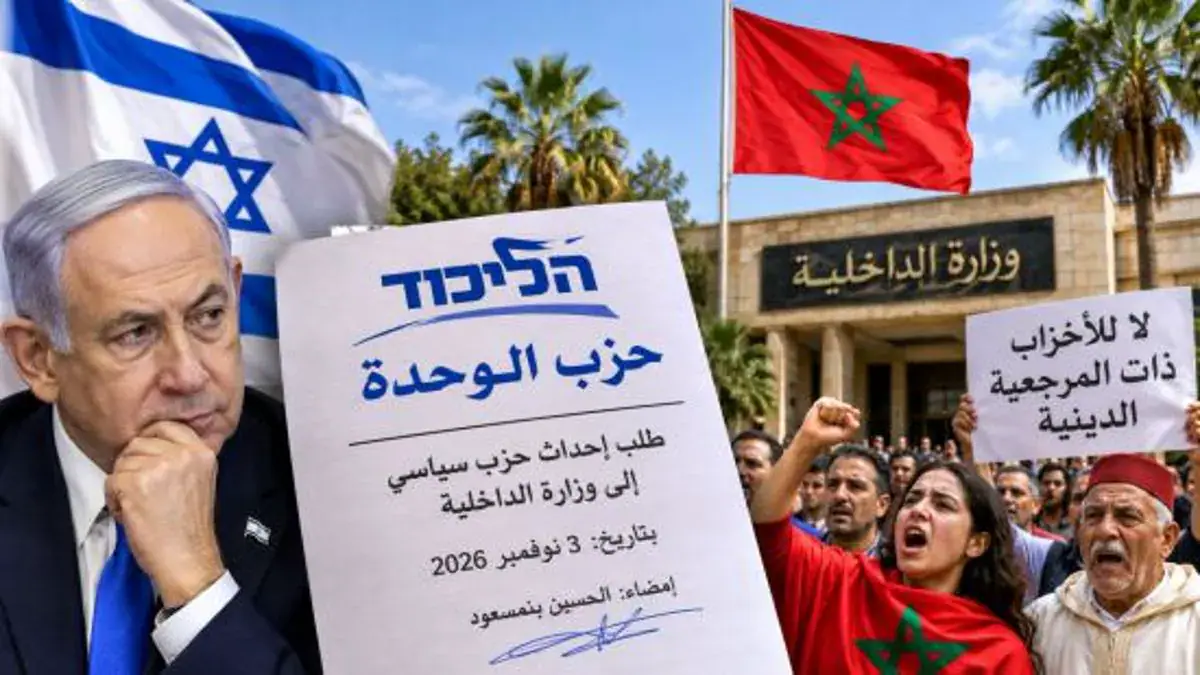
A request to establish a Moroccan political party named 'The Unity Party' with a Hebrew name 'Likud' has triggered a heated debate in Morocco. The proposal, submitted to the Interior Ministry on November 3, 2026, has raised concerns about its potential implications on the country's politics and constitution. The request was made by Hussein Bensmaoud, who claimed to be speaking on behalf of the party's founding coordination committee.
The proposed party's name has drawn parallels with the Israeli Likud party led by Benjamin Netanyahu, sparking concerns about its potential links to Israeli politics. While there is no documented evidence of an organizational or institutional connection between the Moroccan initiative and the Israeli Likud party, the name choice has raised questions about the intentions of the proposal. Critics argue that the move could be seen as an attempt to promote a specific ideology or agenda.
The proposal has been met with criticism from various Moroccan figures, who argue that using religious and cultural references in political projects related to normalization with Israel poses problems that go beyond the establishment of a new party. Ahmed Weyhman, head of the Moroccan Observatory Against Normalization, warned against using religious and cultural identities in political projects linked to normalization.
The debate has also highlighted the issue of using religion in politics, with some arguing that it could lead to divisions within Moroccan society. Dr. Idris Al-Kanbouri, a Moroccan researcher, questioned the use of the concept of 'Commander of the Faithful,' which is a reference to the Moroccan monarch's role as a defender of Islam. He argued that this concept is meant to guarantee freedom of worship for all citizens, not to extend the Islamic institution's scope to include other religious references.
Morocco's constitution clearly states that political parties cannot be established on a religious, linguistic, ethnic, or regional basis. The country's laws also stipulate that any party founded on such grounds would be considered null and void. While Moroccan Jewish citizens have the right to participate in politics and join existing parties, establishing a party based on a specific religious reference raises constitutional concerns.
Authorities in Morocco have denied that the proposal has any legal standing, stating that the submitted document is merely a one-page letter with no legal implications. They emphasized that the country's legislation explicitly prohibits the establishment of parties based on religious grounds. As the debate continues, many questions remain unanswered about the proposal's true intentions and potential consequences.
The controversy surrounding the proposed 'Likud Party' has also brought attention to Morocco's normalization with Israel, which has been a contentious issue within the country. Critics argue that the proposal could be seen as an attempt to promote Israeli-style politics in Morocco, which could further polarize the country's already divided public opinion on the issue.
Key points
- The proposed party's name has drawn parallels with the Israeli Likud party led by Benjamin Netanyahu.
- Critics argue that the move could be seen as an attempt to promote a specific ideology or agenda.
- Morocco's constitution prohibits the establishment of parties based on religious grounds.