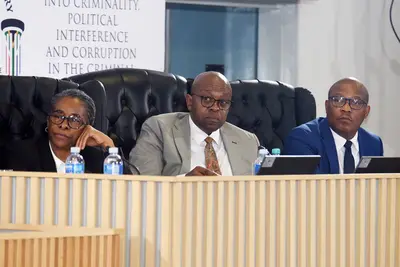
The Madlanga commission of inquiry, led by Mbuyiseli Madlanga, has exposed a concerning trend of public servants dodging accountability. During the inquiry, some officials have demonstrated a lack of understanding of their role as custodians of the public purse. They are expected to exercise transparency and fairness in their duties, but some have sought to evade accountability. This trend was observed in the testimony of Major-General Feroz Khan, who was subpoenaed to appear before the commission after serious allegations were made against him.
Khan, who was accused of facilitating the movement of drugs and interfering with high-level investigations, used various tactics to avoid accountability. He missed his first scheduled subpoena on July 1 and failed to appear again on September 1, citing medical reasons. However, the commission scrutinized his medical certificates, noting that some of his historical medical notes were backdated and modified. Khan also used legal mechanisms to avoid accountability, including approaching the high court to prevent commission investigators from accessing his personal electronic devices.
The commission's proceedings also revealed that Khan insisted on giving his evidence in private, using every tactic to avoid accountability. In contrast, Andrea Johnson, the former head of the Investigating Directorate Against Corruption (Idac), demonstrated an understanding of her role as a public servant. Her testimony was marked by concessions that showed a lot was rotten within the state of Idac. She approved charges against Lieutenant-General Dumisani Khumalo and six others on charges of fraud and corruption, but later conceded that the charges were unfounded.
Johnson's concessions illustrate that she had been part of a dark plot that she should never have allowed herself to be drawn into. Her appointment of Dineo Mokwele, who was allegedly unqualified for a senior post within the SAPS, became a point of discussion at the Madlanga inquiry. However, the commission declared that Mokwele was highly qualified for the post, and Johnson eventually conceded and publicly apologized to Mokwele. This led to the national Director of Public Prosecutions investigating evidence that led to Khumalo and six others' arrest.
The investigation resulted in a decision to withdraw the charges against Khumalo and six others, as it became clear that they were arrested on nefarious grounds. Johnson's resignation on July 26 was interpreted by some as a sign of accepting accountability, while others saw it as an avoidance of accountability. Public confidence in institutions tasked with combating corruption depends on transparency, accountability, and the willingness of those entrusted with public responsibilities to be held to the highest ethical standards.
The Madlanga commission of inquiry has extended its final report deadline to November 16, and its work continues without fear, favour, or prejudice. The inquiry has revealed a culture of dodging accountability among some public servants, who seem to prioritize their own interests over the public good. This trend undermines public trust in institutions and highlights the need for greater transparency and accountability in the public sector.
The Madlanga commission's findings have significant implications for the South African public sector. The commission's work underscores the importance of holding public servants accountable for their actions and ensuring that they are transparent in their decision-making processes. Ultimately, the public sector must prioritize the public good and work to rebuild trust with the South African public.
Key points
- The Madlanga commission of inquiry has exposed a culture of dodging accountability among public servants in South Africa.
- Major-General Feroz Khan used various tactics to avoid accountability, including missing subpoenas and using legal mechanisms to evade scrutiny.
- Andrea Johnson's testimony revealed a dark plot within the state of Idac, and her resignation was interpreted by some as a sign of accepting accountability.