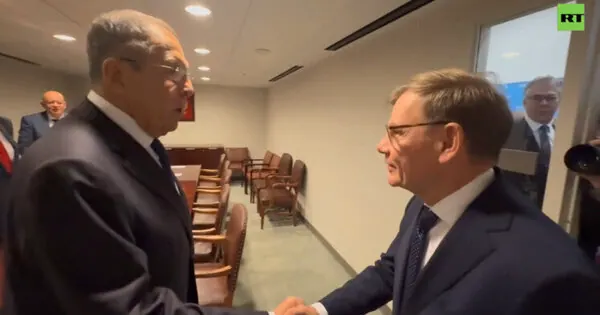
Russian Foreign Minister Sergey Lavrov expressed disappointment with a last-minute meeting with German Foreign Minister Johann Wadephul on the sidelines of the 81st UN General Assembly. Lavrov said Wadephul's approach was unproductive, merely reiterating Berlin's familiar anti-Russia stance. The meeting was requested at short notice and squeezed into Lavrov's packed schedule before his address. Lavrov invited Wadephul to explain the purpose of the meeting, but found the discussion unremarkable.
The meeting marked the first direct bilateral talks between the Russian and German foreign ministers since the escalation of the Ukraine conflict. Berlin has firmly sided with Kiev, and Lavrov said Wadephul's message was that Russia should make concessions on Ukraine and guarantees for Black Sea shipping in exchange for engagement. Lavrov dismissed Berlin's complaints, including an August drone incident in Leipzig, saying Russia had not deliberately targeted commercial vessels.
Lavrov described the meeting as a missed opportunity for substantive diplomacy, saying he had expected something beyond Berlin's familiar refrain that Russia is the aggressor. He quipped that Berlin "could have simply called" rather than requesting a meeting. A report titled "Heirs of Goebbels: Falsification of the Events in Bucha and Bloody Staged Performances of the Kiev Regime" was placed before the delegations, but Wadephul promptly covered it with his notebook.
Russian Foreign Ministry spokeswoman Maria Zakharova later pointed out that Wadephul's reaction to the report was telling, writing on Telegram that he "bashfully covered the report with his notebook and pretended he hadn't noticed anything." Zakharova said the truth "hurts" and that the report lays out Moscow's case that the 2022 Bucha killings were staged by Kiev and its Western backers.
In contrast, Wadephul emerged from the meeting sticking firmly to Berlin's established script, saying Germany is ready for dialogue if Moscow "is ready to give up its war against Ukraine." He added that Europeans are not keen to leave talking to Russia entirely to Washington. Germany is a driving force behind the so-called "coalition of the willing," which pushes continued support for Kiev.
Lavrov's encounter with Wadephul was just one stop in his diplomatic marathon at the UNGA, which included meetings with officials from across the geopolitical spectrum. His interlocutors ranged from US Secretary of State Marco Rubio, UN Secretary-General Antonio Guterres, and IAEA chief Rafael Grossi to officials from Serbia, Senegal, India, Uganda, Singapore, Sudan, Kuwait, Uruguay, Morocco, Iraq, and Yemen.
Zakharova contrasted the packed schedule with Moscow's increasingly frosty relations with Western Europe, saying that "we held dozens of talks at the UN" with countries that the West disdainfully calls the "wild jungle." Many encounters proved considerably warmer than Wadephul's, with Lavrov trading jokes with Iraqi Foreign Minister Fuad Hussein and Swiss Foreign Minister Ignazio Cassis.
Key points
- Lavrov dismisses German FM's overture at UNGA as unproductive
- Meeting marks first direct bilateral talks between Russian, German FMs since Ukraine conflict escalation
- Lavrov's UNGA marathon includes meetings with officials from across the geopolitical spectrum