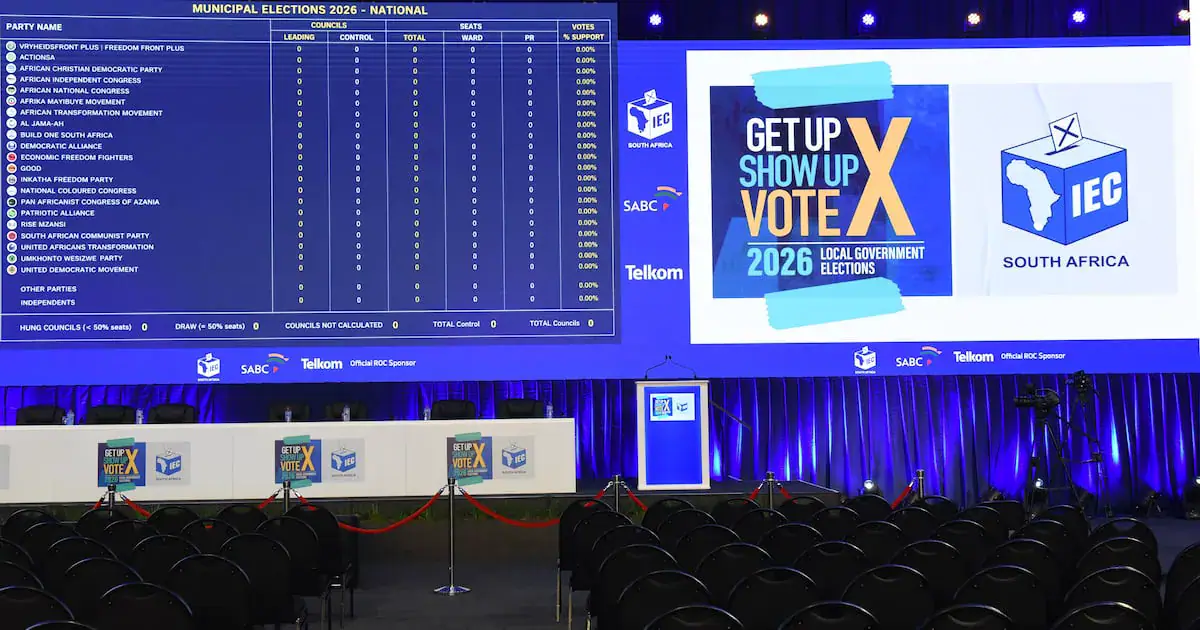
The Electoral Commission of South Africa (IEC) has reported a significant improvement in the processing of results for the 2026 local government elections. By 9am on Thursday, 18 municipalities had completed the results process, a notable increase compared to previous elections. IEC chief electoral officer Sy Mamabolo attributed this progress to enhanced efficiency measures.
As of Thursday morning, the IEC had received 23,444 results slips, representing 35.5% of the expected 66,073 results from local municipalities, metros, and district councils across the country. Of these, 22,983 results slips, or 34.8%, had been captured into the results system, while 16,791, or 25%, had undergone independent auditing. This progress indicates a marked improvement over the 2021 local government elections.
Comparing the current progress to the 2021 local government elections, Mamabolo noted that only seven municipalities had completed the results process at the same stage. The improved rate of capturing results was achieved despite longer ballot papers, an increased number of contestants, and expectations of greater voter participation. The IEC has implemented several safeguards to protect the integrity and transparency of the results process.
To ensure the accuracy and transparency of the results, the IEC has put in place measures such as capturing results slips in duplicate in the presence of political party agents and observers at counting stations. Results slips are also transported in tamper-evident envelopes to the commission's local capturing sites. Additionally, the capturing process includes pre-quality assurance measures, double-blind capturing, scanning of results slips, and independent auditing of the entire population of results.
The IEC's automated results system is designed to identify possible anomalies, including excessive voter turnout and discrepancies in the votes received by a political party at the same voting station across different ballot types. This system provides an additional layer of protection to ensure the accuracy of the results. The commission's verification and auditing measures are intended to ensure that the figures eventually announced accurately reflect the choices made by voters.
Meanwhile, DA Joburg mayoral candidate Helen Zille expressed optimism about the party's performance as the counting process continued. She believed that the DA could emerge as Gauteng's biggest party, although she was careful to limit her comments to Johannesburg, saying she could not speak on behalf of the party nationally. Zille attributed the party's potential success to its hands-on campaign efforts.
Reflecting on voter participation, Zille noted that while she would have preferred a higher turnout, she appreciated those who made their way to voting stations. The IEC maintained that its verification and auditing measures were crucial to ensuring the accuracy and integrity of the results process. The commission's efforts aim to provide a transparent and reliable outcome for the 2026 local government elections.
Key points
- The IEC has reported a significant improvement in results processing, with 18 municipalities completing the process by 9am on Thursday.
- The DA's Helen Zille expresses optimism about the party's performance in Gauteng, citing its hands-on campaign efforts.
- The IEC has implemented various safeguards to ensure the integrity and transparency of the results process, including capturing results slips in duplicate and independent auditing.