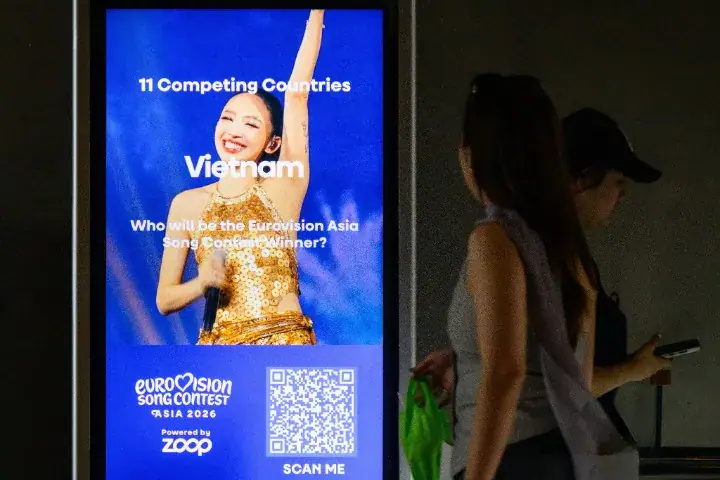
The Eurovision Song Contest is staging its first Asian edition in Bangkok on November 14, featuring 11 countries from Laos to Mongolia and the Philippines. The event will be broadcast live on television in participating countries and on YouTube. Despite being the world's biggest televised live music event, drawing 131 million viewers in 2026, the Asia edition faces challenges, including sluggish ticket sales and the absence of major countries like India, Japan, and China.
The inaugural Eurovision Song Contest Asia has been years in the making, with executive producer Assaf Blecher stating that three years of preparations have fostered a public appetite for the show. Blecher acknowledged that Eurovision is "very big in Europe, and it's very new in Asia," but expressed hope that the event will be the first of many. The finalists were chosen through national competitions, with some established stars like Vietnam's Toc Tien, a favorite to win with her pop-dance track.
The Asia edition of Eurovision comes as the European song contest marks its 70th birthday under a cloud, with 2026 viewing figures down 35 million on the year after a boycott by five countries over Israel's participation. Eurovision has always been marked by controversy, from protests in the 1960s over the participation of Franco-ruled Spain to Russia's exclusion over the 2022 invasion of Ukraine. The show was first held in 1956 as an experiment by national public broadcasters and became a cultural phenomenon.
The Eurovision Song Contest Asia will feature a diverse range of performers, including K-pop star Junhee from South Korea, an all-male a cappella beatbox collective from Bangladesh, and Pratik Himal Rai from Nepal. The entries to Eurovision Asia are mostly love songs, but some, like Philippine pop singer Carmelle's "Sobra-Sobra" (Too Much), an upbeat call to female empowerment, offer a more meaningful message.
Despite the excitement around the event, some experts have expressed concerns that the show lacks provocation or meaningful messaging that can resonate with international audiences. Dean Vuletic, an author and expert on Eurovision, noted that this is what makes Eurovision in Europe special from other song contests. The show has also been hit by production issues, including a reported budget cut of one million dollars.
The performers for Eurovision Asia were due to arrive in Bangkok this weekend for rehearsals ahead of the final show. Some will sing in their native language, while others, like Malaysian star Aina Abdul, will perform in English to reach a wider audience. For Bhutan's Nyendra, who is performing his folk-pop love song in traditional dress, the show offers a platform well beyond his country of 800,000 inhabitants.
The future of Eurovision Asia looks promising, with Blecher stating that he already has 16 or 17 places interested in a 2027 edition. Potential hosts include China, Hong Kong, and Taiwan, a selection that would certainly put the contest on the geopolitical map. As the event approaches, fans and performers alike are eager to see how Eurovision Asia will unfold and what impact it will have on the music industry.
Key points
- The Eurovision Song Contest Asia features 11 countries competing in the inaugural event in Bangkok.
- The event faces challenges, including sluggish ticket sales and the absence of major countries.
- The future of Eurovision Asia looks promising, with potential hosts already expressing interest in the 2027 edition.
Reporting sources
- Eurovision brings pop and politics to Asia · Kenya Broadcasting Corporation