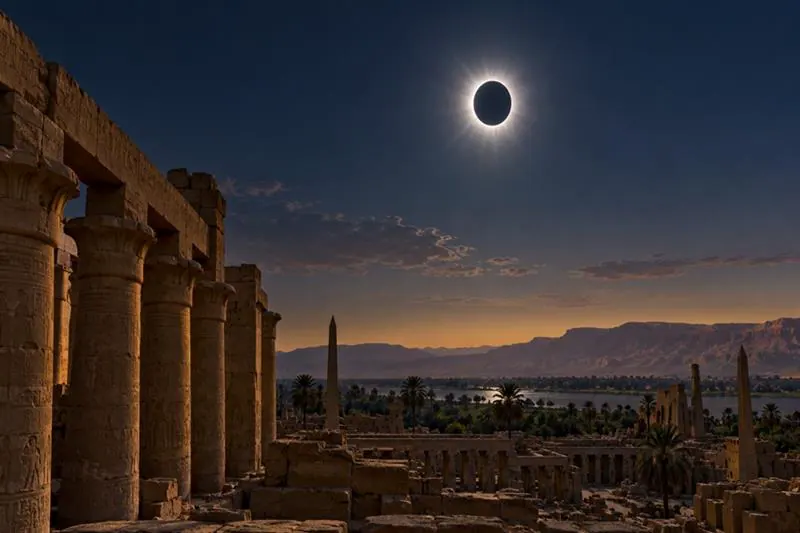
Egypt is preparing to host visitors for the 2027 total solar eclipse, with Luxor and Siwa as the focus of the country's planned viewing events. The Tourism and Antiquities Ministry says these two destinations will experience extended totality, with Luxor seeing about six minutes and 22 seconds of totality and Siwa experiencing about five minutes and 31 seconds. The eclipse is expected to draw tourists to these locations, with the ministry coordinating with local authorities to provide suitable facilities.
The Tourism and Antiquities Ministry has formed a committee to prepare for the event, which includes discussing viewing locations, visitor services, transport, and safety arrangements. The committee, formed in May, had its first meeting in September, chaired by Tourism and Antiquities Minister Sherif Fathy. The ministry will coordinate with local authorities to identify suitable sites equipped with restrooms, cafés, and other basic facilities. Officials also discussed domestic flights and road transport between governorates.
In Luxor, tourism and antiquities officials are examining museum and archaeological site visiting hours during the event. The Egyptian Tourism Promotion Authority and tourism industry representatives agreed to develop an eclipse logo and a channel to answer prospective visitors' inquiries. Fathy reaffirmed preparations during a visit to Paris this month. The eclipse will give visitors to Luxor a chance to experience a rare astronomical event amid the city's ancient monuments.
The 2027 solar eclipse will be a rare event, with a maximum totality of about six minutes and 23 seconds near Luxor, making it the second-longest total solar eclipse of the 21st century. The longest was on 22 July 2009, when maximum totality lasted about six minutes and 39 seconds. The forecast duration at a particular viewing site depends on its position within the eclipse path.
The path of totality will cross parts of Spain, Morocco, Algeria, Tunisia, Libya, Egypt, Sudan, Saudi Arabia, Yemen, and Somalia. Other locations across a much wider area will see a partial eclipse. Spain has launched an official information site for its 2026-2028 eclipses, while Andalusian authorities are assessing viewing sites, traffic, and safety for the 2027 event.
Internationally, researchers plan to deploy 10 telescopes along the eclipse path in Morocco. Algeria's astronomy research centre has described an earlier observing mission as preparation for 2027. Libya's tourism minister has asked officials to study a proposal for an international viewing event in Benghazi. In contrast, a Sfax official in Tunisia has discussed coordinating eclipse-related activities with tourism operators.
As Egypt prepares for the 2027 solar eclipse, the country expects to accommodate tourists traveling to watch the event. The ministry will ensure that visitors have a safe and enjoyable experience, with proper solar protection during the partial phases. Direct viewing is safe only during complete totality. The event is expected to boost Egypt's tourism industry, with the country aiming to attract 20 million tourists by the end of the year.
Key points
- Luxor and Siwa are the prime viewing locations for the 2027 total solar eclipse in Egypt.
- The 2027 solar eclipse will be the second-longest total solar eclipse of the 21st century.
- Egypt's tourism industry is gearing up to accommodate tourists traveling to watch the 2027 solar eclipse.