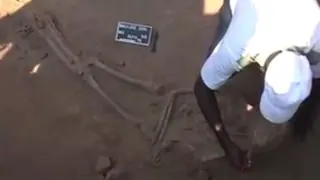
Archaeologists have made a groundbreaking discovery in Senegal, unearthing the remains of an ancient human, named Hamady Walaldé, in the Walaldé site, located near Boobhobé village. The findings, a result of excavations conducted in the late 1990s, have provided valuable insights into the lives of early agropastoral communities in the region. The site, spanning around five hectares, was occupied between 800 and 550 BCE, and the human remains date back to this period.
The excavations, led by researchers Hamady Bocoum, Alioune Dème, and Susan McIntosh, revealed a community that had mastered ironworking, with evidence of metal processing and tool production. The presence of copper from Akjoujt indicates that the inhabitants had established trade networks with distant regions. The site has also yielded a range of ceramics and several burials with red ochre, suggesting complex cultural practices.
In 2015, a documentary titled "Le Premier Homme du Fouta: Hamady Walaldé" presented the fossil to the public, sparking debates about the individual's ethnic affiliation. Some experts cautioned against drawing conclusions about the person's ancestry, citing that the earliest known inhabitants of the Fouta region may not necessarily have been Peul, but could have belonged to other groups such as the Sérères or Bambaras.
The discovery has also sparked discussions about the site's significance in local oral tradition. According to legend, Walaldé is linked to the ancient city of Mawndou Walaldé, located in present-day Mauritania, where the remains of former kings and dignitaries were allegedly buried. The findings have shed new light on the region's rich cultural heritage and history.
The research team employed advanced techniques to analyze the human remains and artifacts, providing a more detailed understanding of the lives of early inhabitants in the region. The study of the skeleton has helped researchers to reconstruct the diet, lifestyle, and cultural practices of the community, offering a unique glimpse into the lives of people living in the region over 2,500 years ago.
The presentation of the fossil in the documentary has generated significant interest and debate among scholars and the general public. While some have hailed the discovery as a major breakthrough, others have emphasized the need for caution and further research to fully understand the significance of the findings. The site continues to be an important area of study, with ongoing research aiming to uncover more secrets about the lives of early humans in the region.
The discovery of Hamady Walaldé serves as a testament to the rich cultural heritage of Senegal and the importance of preserving and studying the country's archaeological sites. As researchers continue to unravel the secrets of the past, the findings will undoubtedly contribute to a deeper understanding of human history and the development of civilizations in the region.
Key points
- The discovery provides new insights into the lives of early agropastoral communities in the region, dating back over 2,500 years.