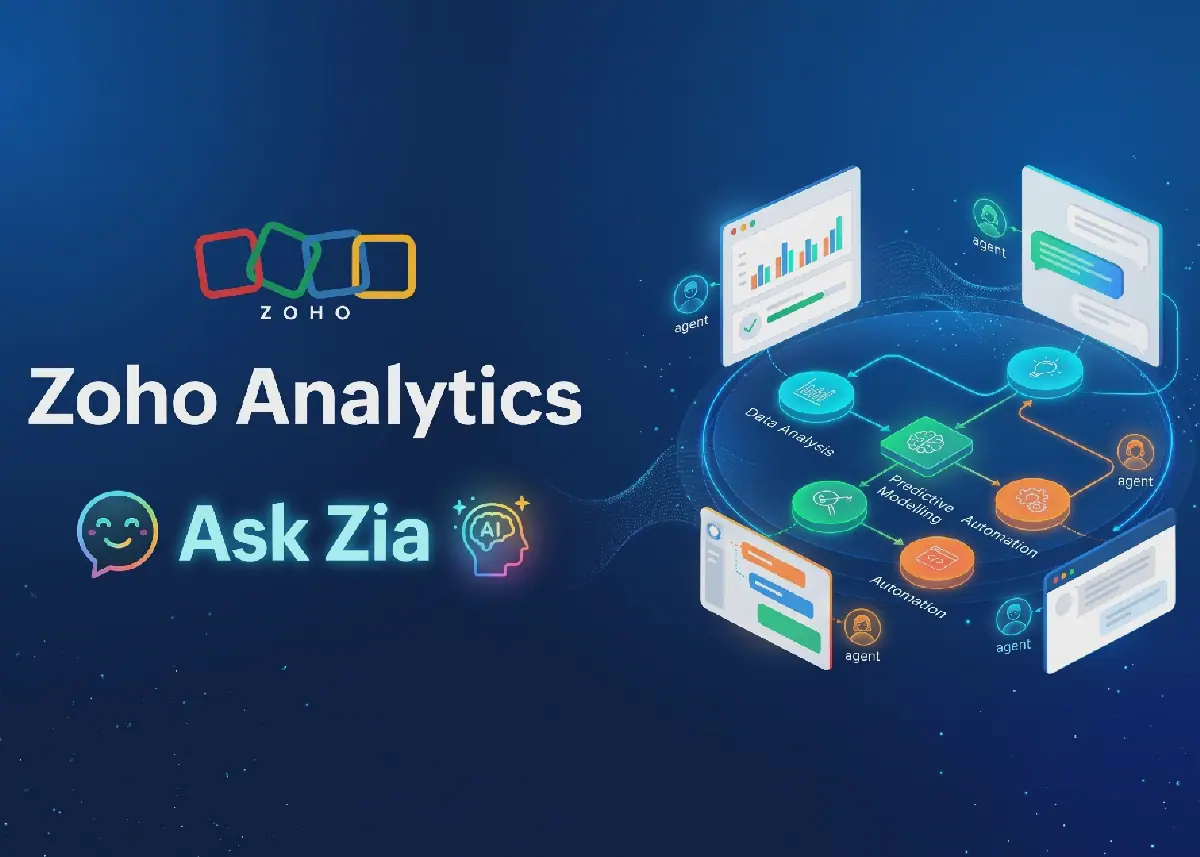
Zoho is upgrading its Analytics platform with AI agents designed to help businesses make data-driven decisions. The update introduces Ask Zia, a conversational AI assistant that enables users to ask questions in natural language and receive analysis, visualizations, and workflow initiation. This development aims to make business intelligence more accessible to employees without technical expertise in data analysis. By centralizing various processes, Zoho seeks to streamline data analysis and decision-making.
The AI agents are built on a multi-agent architecture that coordinates specialized agents for data analysis, visualization, preparation, modeling, coding, and actions. This approach distributes tasks among agents, allowing for more efficient and accurate analysis. According to Veerakumar Natarajan, Country Head of Zoho Kenya, "We are at the beginning of the next leap forward in data analytics, where a strong data foundation is the starting point for all agentic activity in business operations." This architecture enables Ask Zia to handle complex tasks and provide more accurate insights.
To improve the agents' understanding of organizations, Zoho has introduced two new layers: the semantic layer and the ontology layer. The semantic layer sets up a shared glossary for terms, metrics, and definitions, ensuring that AI agents understand the context and nuances of an organization's data. The ontology layer maps how entities such as customers, products, and departments connect, allowing the AI to see how different parts of the business fit together. This enables more accurate and relevant analysis.
Zoho allows businesses to build custom agents grounded in their own data, business models, and knowledge bases. The platform also supports multiple AI models, including its own large language model (LLM) and configurable external models. The Model Context Protocol (MCP) enables outside AI assistants to work with Zoho Analytics data and capabilities. For instance, the Claude integration allows users to work with Zoho Analytics from within Claude, expanding the platform's capabilities.
With the increased use of AI agents, data privacy and control become essential considerations. Zoho ensures that customer data is not used to train its AI models, but businesses connecting external services may share query results with those providers. Administrators have control over AI features, data access, and agent deployment, as well as visibility into agent actions and usage. Zoho's AI observability tools track which agents ran, who used them, and how they responded, providing transparency and accountability.
The accuracy of AI-generated insights depends on the quality of the underlying data, business definitions, and configuration. Zoho's data catalogue supports data lineage and impact analysis, helping organizations understand how information is connected and how changes affect their analytics assets. Sandbox and deployment management tools allow organizations to test agents and analytics assets before publishing them, ensuring that they are reliable and accurate.
The update reflects a broader shift in business software, where AI is moving from answering questions to participating in operational processes. Ask Zia has the potential to reduce technical barriers to analyzing business information, but organizations must still prioritize reliable data, clearly defined permissions, and proper oversight to achieve meaningful results. By providing a more accessible and efficient way to interact with data, Zoho's AI agents can help businesses make more informed decisions.
Key points
- Zoho introduces AI agents to enhance business intelligence, allowing users to interact with data through natural language.
- The platform supports multiple AI models and allows businesses to build custom agents grounded in their own data and knowledge bases.
- Administrators have control over AI features, data access, and agent deployment, ensuring data privacy and control.