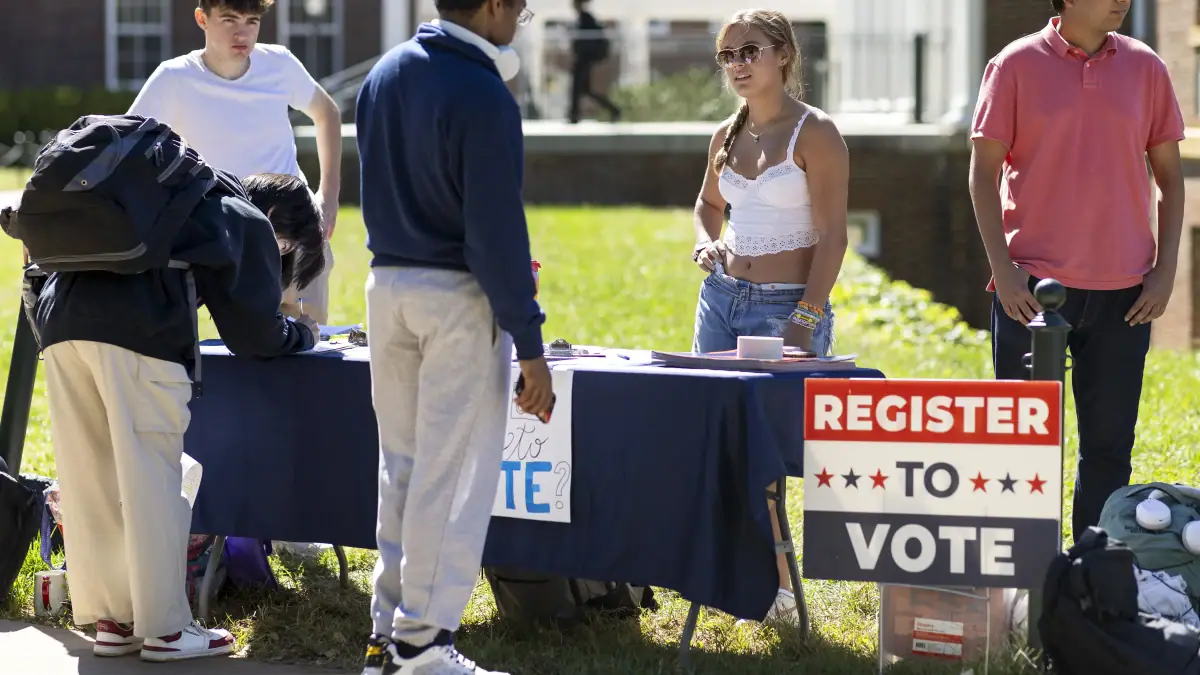
A Supreme Court ruling in 1979 affirmed the right of eligible students to register in the communities where they live during the academic year. However, some people continue to question why students can vote in their college towns. This issue has sparked debate, particularly in Montana, where a new restriction on student voters was introduced last year. The restriction was blocked by a state judge, leaving previous rules in place for Montana students who want to register to vote.
According to Michael Hanmer, a professor of government and politics at the University of Maryland, voting in the US is tied to residency, and state and local governments determine who qualifies as a resident who can register. Federal law sets ground rules for residency requirements to ensure that certain voters, such as eligible students, are not discriminated against. Hanmer explains that college students need to be treated the same as anybody else in the mix who might be new to a particular place.
Like owners of multiple homes, many students are able to choose which of their residences to be that somewhere for registering to vote. In the legal world, it's known as their "domicile." Yael Bromberg, an attorney who co-edited the book Youth Voting Rights: Civil Rights, the Twenty-Sixth Amendment, and the Fight for American Democracy on College Campuses, explains that domicile is defined as the one singular, fixed, permanent, principal home where one intends to return.
In Montana, a US citizen who is 18 or older and has been a state resident for at least 30 days is generally eligible to register to vote there. However, the new restriction introduced last year could force thousands of students to lose the ability to have a say at the ballot box about how their communities are run. The Montana Public Interest Research Group claims that the change to Montana's residency rule could have a significant impact on student voters.
The issue has sparked debate, with some arguing that student voters from outside Montana should not be able to affect the state's elections. However, Hanmer does not see Montana's law clearing legal hurdles. He points out that student voters who do have the right to choose where to register should keep in mind that, in some states, that choice may come with other requirements.
Certain states require a new resident to, for example, get a new state ID or change their car registration. Hanmer adds that these restrictions can be imposed, but they are imposed on all new residents, not just college students. The debate highlights the complexities of student voting rights and the need for clarity on the rules and regulations surrounding residency requirements.
As the wait continues for the judge's final ruling in Montana, student voters and advocacy groups are watching closely. The case has implications for student voters across the US, and experts say it serves as a reminder of common misunderstandings about the rights of some of the country's youngest voters. The issue is likely to continue to be a topic of discussion in the lead-up to future elections.
Key points
- Student voters have the right to choose where to register to vote
- Montana's new restriction on student voters was blocked by a state judge
- Student voters may face additional requirements when registering to vote in a new state