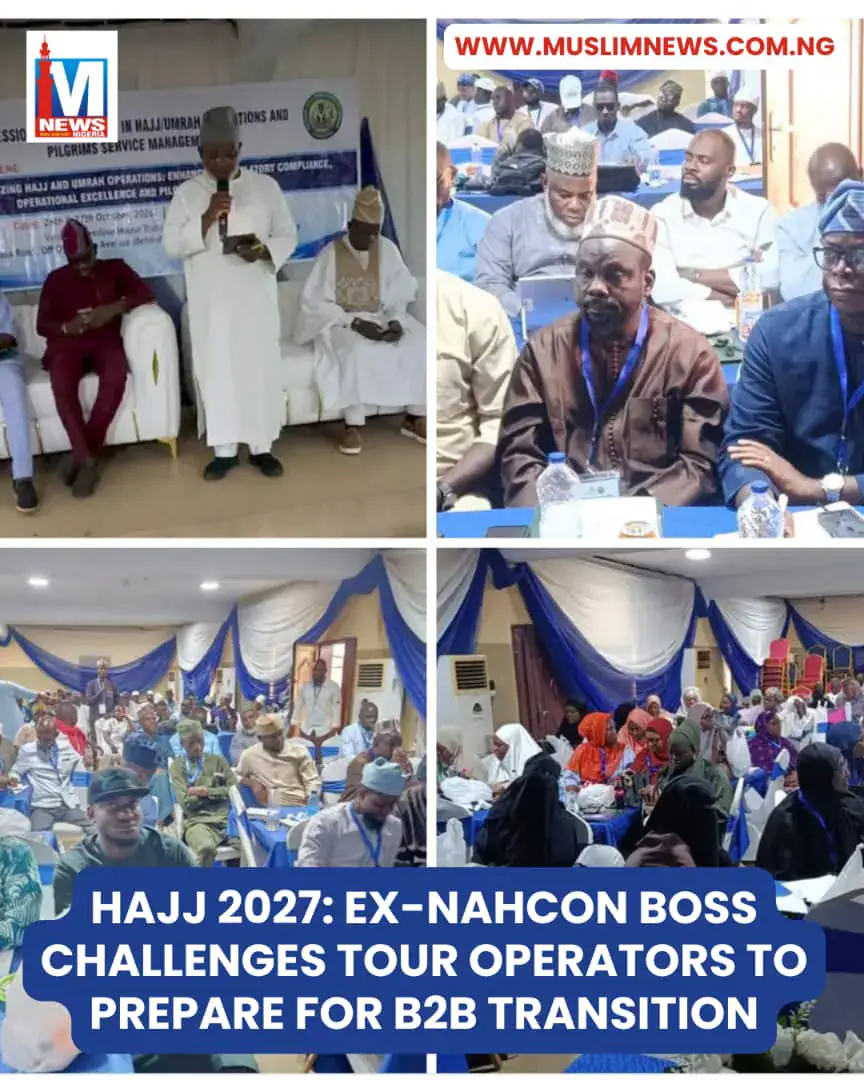
Former Chairman and Chief Executive Officer of the National Hajj Commission of Nigeria (NAHCON), Alhaji Zikrullah Kunle Hassan, has called on Nigerian Hajj and Umrah tour operators to enhance their institutional, financial, technical, and managerial capacity. This is in preparation for the proposed Business-to-Business (B2B) model, which will see private operators manage up to 98 per cent of pilgrims. Hassan made this appeal on October 27, 2026, during a professional certificate programme in Hajj and Umrah Operations and Pilgrim Service Management in Lagos.
The two-day programme was organised by NAHCON, the Hajj Institute of Nigeria (HIN), the Association for Hajj and Umrah Operators of Nigeria (AHUON), and the Hadaya and Umrah Tour Operators of Nigeria (HUTON). Hassan stressed that greater private-sector participation would require operators to demonstrate professionalism, accountability, and consistent service delivery. He identified Saudi Arabia’s Vision 2030 reforms as a major driver of change in the global Hajj industry, with a focus on digitalisation, private-sector participation, and measurable service quality.
Hassan commended the current leadership of NAHCON, under Ambassador Ismail Abba Yusuf, for its diplomatic engagement with Saudi authorities. This engagement has provided Nigeria with a phased transition, beginning with 30 per cent private-sector participation in 2027. He noted that the proposed B2B model would reshape operators’ responsibilities and require them to demonstrate competence, credibility, and consistent service delivery to remain competitive.
The former NAHCON chairman emphasised the importance of regulatory compliance as a foundation of professional Hajj and Umrah operations. He urged operators to meet the legal, financial, and contractual requirements governing pilgrimage management in Nigeria and Saudi Arabia. Hassan described compliance as a shared responsibility, with NAHCON expected to provide clear guidelines, timely communication, and consistent oversight.
On operational excellence, Hassan stressed that Hajj was a complex international operation requiring coordinated management of accommodation, transportation, feeding, healthcare, and religious guidance. He urged operators to establish service-level agreements with suppliers and prepare contingency plans for potential disruptions. Hassan also called for greater investment in digital registration, secure document management, and real-time communication.
Hassan described pilgrim satisfaction as a central measure of professional pilgrimage management, reminding operators that Hajj was not an ordinary commercial journey. He urged operators to establish effective systems for collecting feedback, responding promptly to complaints, and using lessons from each pilgrimage exercise to improve subsequent operations. According to Hassan, commercial sustainability and pilgrim satisfaction should reinforce each other.
The former NAHCON chairman also urged tour operators and their associations to strengthen unity and cooperation as private-sector responsibilities expand. He warned that fragmentation and unhealthy rivalry could weaken the industry’s ability to meet the demands of the emerging Saudi business model. Hassan outlined five priorities for operators preparing for greater private-sector participation: continuous professional certification, stronger corporate governance, operational excellence, pilgrim satisfaction, and collaboration.
Key points
- Former NAHCON chairman Zikrullah Kunle Hassan challenges Nigerian Hajj tour operators to strengthen capacity ahead of 2027 Hajj
- Proposed B2B model will see private operators manage up to 98 per cent of pilgrims
- Hassan emphasises regulatory compliance, operational excellence, and pilgrim satisfaction as key priorities for tour operators