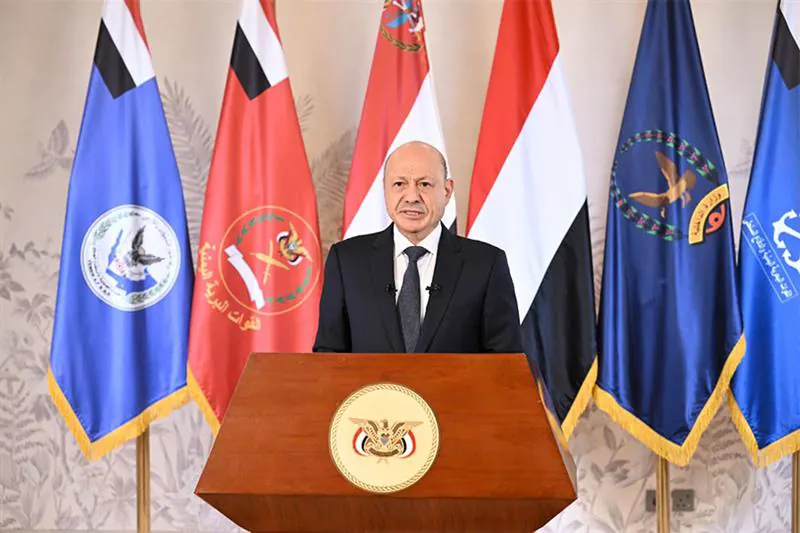
Yemen's Presidential Leadership Council Chairman Rashad Al-Alimi announced on Sunday, October 4, 2026, the start of military operations to retake the country's remaining territory from the Houthi movement and restore state authority across Yemen. In a televised statement, Al-Alimi said all opportunities for de-escalation had been exhausted and that the decision was taken based on resolutions of the National Defence Council. He instructed the armed forces, security forces, and all military formations to begin carrying out their assigned missions.
The announcement marks a shift from a period of preparation and mobilization to an "action" phase. Al-Alimi accused the Houthis of responding to de-escalation efforts with further mobilization and escalation, attacks, and threats against civilians, national facilities, neighbouring countries, and international waterways. The government, based in Aden, controls much of the country's south and east, while the Houthis control most of northwest Yemen, including Sanaa.
The humanitarian situation in Yemen is reaching catastrophic proportions, with 40 million people enduring what aid agencies say is "the world's third worst hunger crisis." About 22 million people need humanitarian assistance, and 5.2 million people are already internally displaced. The United Nations estimated that more than 80,000 people have been displaced by the fighting since the start of September 2026.
Al-Alimi stressed that the military campaign was not directed against residents of Sanaa, Saada, Hodeidah, or any other Yemeni province, and was not a conflict against any religious sect or tribe. He urged residents of areas under Houthi control to stay away from military positions, gatherings, and supply routes, and to prevent their children from being drawn into the fighting.
Al-Alimi instructed the armed forces, security forces, military formations, and popular resistance forces to strictly observe the law and protect civilians, property, and personal dignity. He said the success of the campaign would not be measured solely by the number of cities retaken, but by the number of civilians who regain security, families who return to their homes, and measures taken to prevent a return to killing, oppression, and the confiscation of the people's will.
Alongside the military operations, Al-Alimi said he had instructed the government to prepare a programme to ensure that state institutions resume their responsibilities immediately in each city, district, and province retaken by government forces. The priorities would include restoring state employees' salaries and addressing their outstanding arrears, with support from allies and friends.
Al-Alimi reaffirmed the Presidential Leadership Council and government's commitment to the outcome of the Saudi-sponsored southern dialogue, saying it should lead to a "fair and comprehensive solution" to the southern issue. The government would also launch an urgent recovery and reconstruction programme, repair roads, electricity, water infrastructure, and damaged facilities, and create conditions for displaced people to return and economic activity to resume.
Key points
- The Yemeni government has announced the start of military operations to retake territory from the Houthi movement and restore state authority across the country.
- The humanitarian situation in Yemen is reaching catastrophic proportions, with 22 million people in need of humanitarian assistance.
- The government has committed to protecting civilians and restoring state institutions in areas retaken from the Houthi movement.