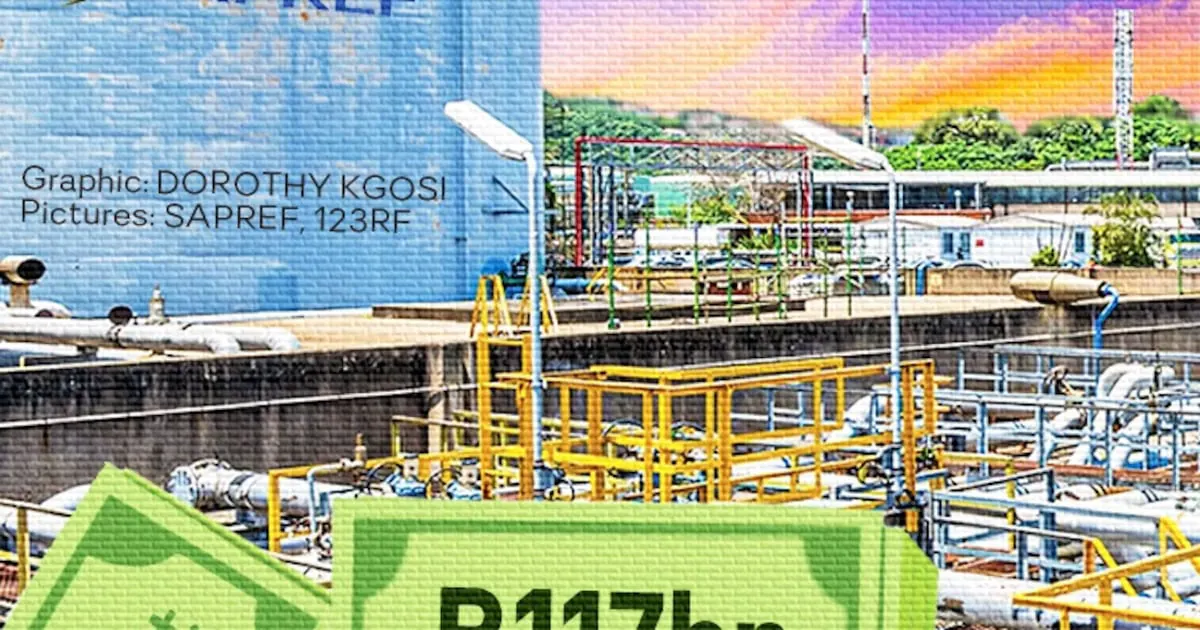
The South African government is contemplating a significant investment of approximately R117 billion to revive and expand refining capacity at South African Petroleum Refineries (Sapref) in Durban. At first glance, the economic rationale appears compelling, particularly given the estimated R76 billion loss to the economy between 2021 and 2024 due to the absence of domestic refining capacity. This loss is attributed to higher imports of refined petroleum products.
However, a closer examination reveals that these two numbers address different questions. The R76 billion estimate is a counterfactual assessment of potential savings had more refining capacity been available. It does not inherently validate the economic viability of spending R117 billion to rebuild or expand refining capacity. The crucial question is not merely whether South Africa requires refining capacity but what exactly the country is acquiring for R117 billion.
The distinction between commercial efficiency and strategic resilience is vital in this context, as petroleum is not an ordinary commodity. A nation can reasonably pay more than the lowest market price for energy security, similar to maintaining military capabilities that are not continuously profitable. The inquiry is how much insurance is necessary and whether the proposed investment is the most efficient means of procuring it.
The current global diesel market highlights the complexity of this issue. Refining capacity can become a constraint in its own right, and disruptions to Russian refining, instability around major Middle Eastern supply routes, and other market disruptions have contributed to exceptionally high diesel and gasoil margins recently. In periods of tight product supply, access to refining capacity can have considerable strategic value.
Nevertheless, exceptional refining margins should not be confused with a permanent competitive advantage. Refinery economics are influenced by crude prices, product demand, refinery utilization, maintenance cycles, transportation costs, and global capacity. A refinery investment expected to operate for several decades cannot be justified solely on the assumption that today's extraordinary margins will persist.
South Africa is faced with several strategic choices, including accepting that refining may not be an area of strong comparative advantage and focusing on becoming better prepared to import refined products. Alternatively, the country could restore Sapref to its former capacity of approximately 180,000 barrels a day or pursue a more ambitious proposal to rebuild and expand Sapref into a refinery of around 400,000 barrels a day.
A hybrid model also deserves consideration, involving retaining a meaningful domestic refining capability, maintaining substantial strategic stocks, securing a portion of requirements through long-term contracts with foreign refiners, and using the spot market for the balance. This approach would enable South Africa to diversify access to refining capacity without having to own all of it, potentially including relationships with major refining centers in countries such as Nigeria, India, or China.
Key points
- The proposed R117 billion investment in refining capacity requires careful consideration of the associated risks and benefits.
- South Africa's decision on refining capacity should be evaluated against five key questions, including the full lifecycle cost of the investment.
- A hybrid model of retaining domestic refining capability and securing long-term contracts with foreign refiners may offer a viable alternative.