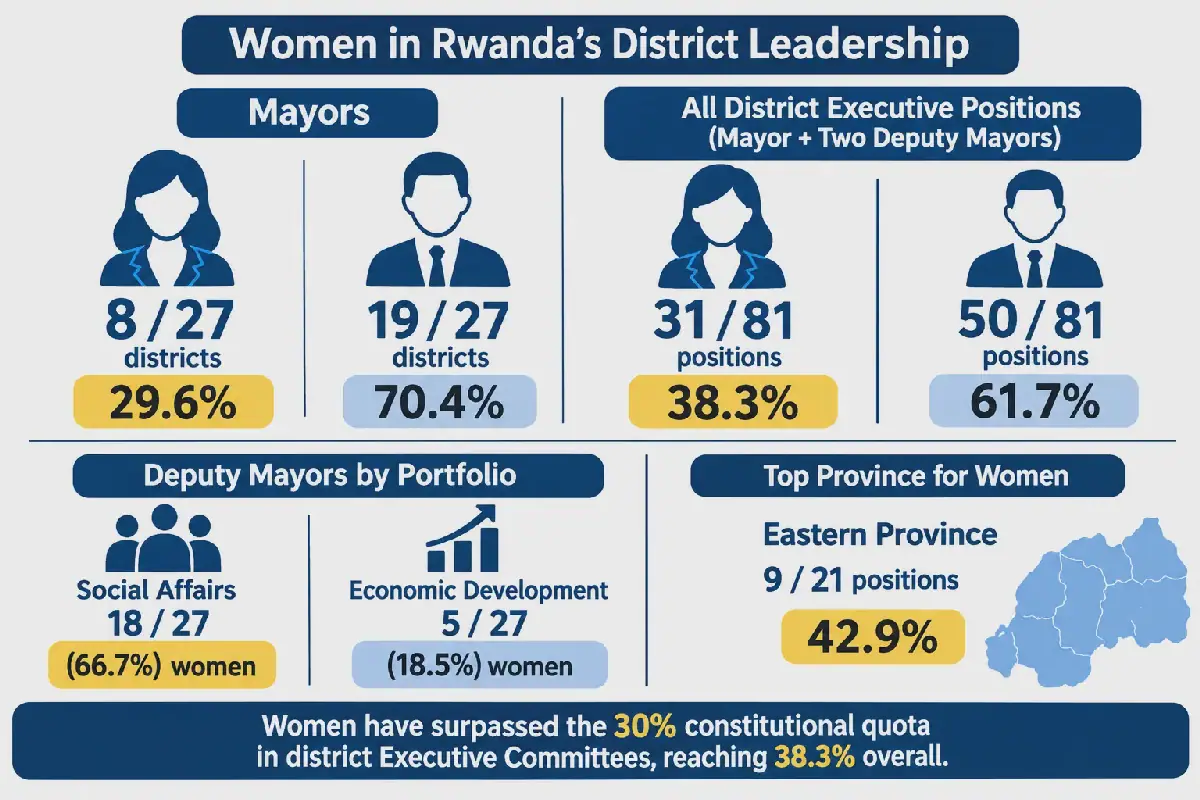
Rwanda's local government electoral season has concluded, with district leadership teams fully constituted except in three City of Kigali districts. The new leadership teams, elected between November 17 and 24, 2026, comprise a mix of new faces and returning leaders. Women have secured eight of the 27 mayoral positions, representing 29.6% of the total, slightly below the constitutional requirement of at least 30% women's representation in decision-making organs.
Eighteen of Rwanda's 27 districts have elected new mayors, while nine outgoing leaders secured another five-year term. The eight districts under women's leadership are Musanze, Ngoma, Nyabihu, Gakenke, Kamonyi, Rwamagana, Rulindo, and Ruhango. Six women are taking up the positions for the first time, while Vestine Mukandayisenga of Gakenke and Nathalie Niyonagira of Ngoma retained their positions. The newly elected female mayors include Marie-Grâce Berwa, Jacqueline Uwingabire, Patricia Murekatete, Sandra Musabwasoni, Chantal Uwamahoro, and Virginie Mukasonga.
Women's representation differs sharply between the two deputy mayor portfolios. Of the 27 deputy mayors responsible for Social Affairs, women occupy 18 positions, representing 66.7%. In contrast, women secured only five of the 27 positions in economic affairs, equivalent to 18.5%. The five districts with women serving as deputy mayors in charge of Economic Development are Burera, Gicumbi, Nyamagabe, Nyaruguru, and Ngororero.
A breakdown of all three Executive Committee positions by province shows that the Eastern Province has the highest proportion of women, with nine occupying 21 positions, representing 42.9%. The Southern Province follows with 10 women among 24 positions, equivalent to 41.7%. The Northern and Western provinces have the same proportion of women, at 33.3%. The Northern Province has five women among 15 Executive Committee members, while the Western Province has seven among 21.
Unlike elections in which residents directly vote for their district leaders, mayors and their two deputies are selected by district councils through an indirect, secret-ballot process. The councils were constituted through elections held on November 17 for women representatives and November 21 for general councillors, alongside representatives of special-interest groups. Each District Executive Committee comprises three members: the mayor, the deputy mayor in charge of Economic Development, and the deputy mayor responsible for Social Affairs.
The newly elected mayors and their Executive Committees will serve from 2026 to 2031, overseeing district development programs, budgets, and service delivery. With most districts getting new leadership, the next five years will test the ability of the incoming administrations to turn their mandates into measurable improvements in residents' lives. For women, the election results mark progress in local government representation.
However, the limited presence of women in economic development positions shows that representation alone does not guarantee an equal share of leadership responsibilities. The three City of Kigali districts – Gasabo, Kicukiro, and Nyarugenge – were not included in the district council elections because they do not have independent District Councils and operate under a different administrative arrangement.
Key points
- Women have secured eight mayoral positions and hold 38% of district leadership roles in Rwanda.
- Women's representation differs significantly between social affairs and economic affairs portfolios.
- The Eastern Province has the highest proportion of women in district leadership positions, at 42.9%.