The Antalya climate summit, also known as COP31, ended without agreement on its proposed overarching decision, the so-called Antalya Pact. The conference, hosted by Türkiye and led by Australia's Minister of Climate Change and Energy, Chris Bowen, was expected to produce a political statement capable of giving direction to the global climate effort. However, the final hours of the summit exposed deep divisions over fossil fuels, climate finance, and the responsibilities of wealthy nations. The failure to secure consensus was a public demonstration of the current fault lines running through the international climate process.
The proposed Antalya Pact was intended to bring together the summit's political ambitions and signal a new phase of implementation. However, it failed to secure consensus, with several countries objecting to its omission of explicit fossil-fuel language, its weak treatment of climate finance, and its promotion of carbon capture technologies. The collapse of the negotiations was more than an embarrassing end to a difficult conference; it was a demonstration of the current challenges facing international climate diplomacy. Wealthy countries were accused of resisting financial obligations, while fossil-fuel interests were accused of shaping the agenda.
For many climate-vulnerable countries and organizations representing frontline communities, the absence of finance, a credible fossil-fuel transition pathway, and a functioning just-transition mechanism made the achievements of the summit feel painfully inadequate. Tasneem Essop, the Executive Director of Climate Action Network International (CAN), described the outcome as "the worst COP ever." Essop's sentiments were striking even by the standards of climate summits, where disappointment has become almost institutionalized. The anger in Antalya was not simply about another set of negotiations ending in compromise; it was about a growing sense that governments are repeatedly agreeing to address the climate crisis while avoiding the decisions and financial commitments needed to do so.
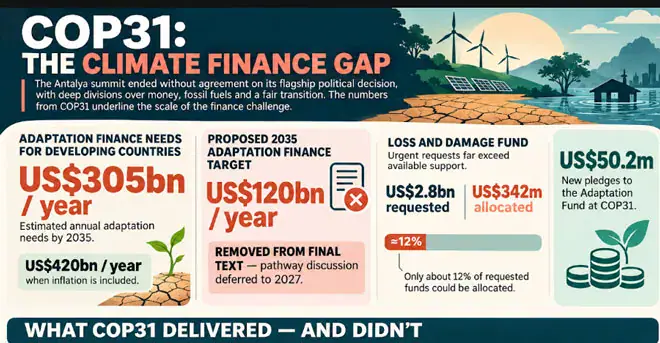
The summit did deliver some tangible results, including advances on electrification, adaptation, and just transition. However, these achievements were overshadowed by the failure to secure a comprehensive agreement. The proposed 35% electrification target by 2035 was another point of contention, with critics arguing that it was not sufficiently tied to renewable energy. The EU, Panama, Vanuatu, Belize, the Marshall Islands, the United Kingdom, and others objected to the final proposal. The African Group also raised concerns about the absence of a concrete adaptation-finance figure.
Türkiye's environment minister and COP31 president, Murat Kurum, defended the presidencies' efforts, stating that they had done everything they could to secure an agreement. Kurum argued that the presidencies had sought to build on commitments already reached, rather than reopen settled questions. He also suggested that some countries had become fixated on particular words and phrases, preventing the process from moving forward. However, critics argued that the failure to secure consensus was not simply a matter of wording; it went to the heart of the climate bargain.
The disagreement centered on whether countries would make the transition away from fossil fuels explicit and whether wealthy nations would provide the financial support that developing countries say is necessary to make that transition fair. The conference, scheduled to end on November 20, continued for more than 44 hours beyond its deadline before finally closing without a political agreement. The outcome has raised concerns about the ability of governments to address the climate crisis and the financial commitments needed to support vulnerable countries.
The failure of COP31 to reach a comprehensive agreement has significant implications for the global climate effort. The summit's outcome has exposed deep divisions over fossil fuels, climate finance, and the responsibilities of wealthy nations. As the international community looks to future climate summits, it remains to be seen whether governments can overcome their differences and secure a comprehensive agreement that addresses the climate crisis. The outcome of COP31 has also highlighted the need for wealthy nations to provide financial support to vulnerable countries and for a credible fossil-fuel transition pathway to be implemented.
Key points
- The Antalya climate summit failed to reach a consensus on its flagship political decision, exposing deep divisions over fossil fuels, climate finance, and the responsibilities of wealthy nations.
- The proposed Antalya Pact was intended to bring together the summit's political ambitions and signal a new phase of implementation but failed to secure consensus.
- The failure of COP31 to reach a comprehensive agreement has significant implications for the global climate effort, highlighting the need for wealthy nations to provide financial support to vulnerable countries and for a credible fossil-fuel transition pathway to be implemented.
Reporting sources
- COP31: A summit of progress or a failure of climate justice? · The Independent magazine