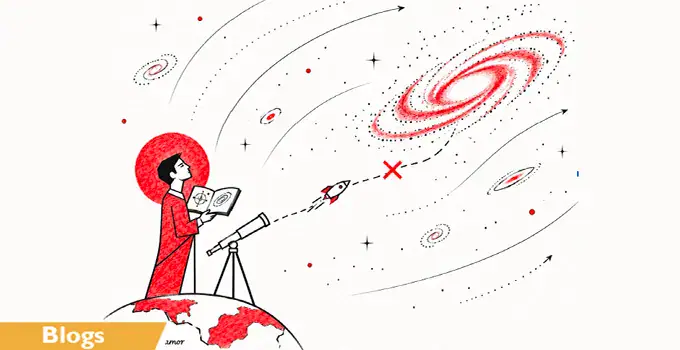
The human perception of the universe has changed significantly over time. In the past, people believed the Earth was at the center of the universe, with the stars forming a distant backdrop. However, with astronomical discoveries, the Earth has become just one planet among many, and the Sun, an ordinary star. Modern telescopes have revealed that the universe is immense and that our ability to explore it is increasing rapidly.
This growing knowledge of the universe has created a contradiction. Humans can now contemplate galaxies that are billions of years away, but their physical existence remains tied to a small planet in a solar system located in a corner of the Milky Way. The human mind can travel almost anywhere, but the body is limited by distances that seem to make any ambition of departure impossible. This contradiction may give rise to a new philosophy, one that focuses on the cosmic horizon.
This new philosophy would not be a doctrine of resignation or a celebration of space conquest. Instead, it would seek to understand what it means to be human in a universe that is vastly larger than our habitable world. It would explore questions such as whether we are confined to the Milky Way or if our existence is limited to our planetary cradle. This philosophy would consider the possibility that our limitations could become the starting point for a new way of thinking about our destiny.
One of the key considerations in this philosophy is the distinction between the observable universe and the actual universe. The observable universe is limited by the age of the cosmos, the speed of light, and the history of expansion. The diameter of the observable universe is estimated to be around 92 billion light-years. However, this does not mean that the universe ends there; it could extend far beyond what we can observe.
The expansion of the universe adds another layer of complexity. Galaxies are not simply moving away from each other in a static space; the space itself is expanding on a large scale. This means that some galaxies may become permanently inaccessible to any future signal. As a result, the visible universe and the universe that we could potentially reach are not the same.
The example of Andromeda, the closest major galaxy to the Milky Way, highlights the challenges of intergalactic travel. At a distance of around 2.5 million light-years, Andromeda is almost unimaginably far away. Even at high speeds, it would take millions of years to reach Andromeda, and the universe would likely have changed significantly by then. According to the theory of relativity, time dilation could make the journey seem shorter for those on board, but this remains purely theoretical.
The exploration of Andromeda also raises questions about the nature of human existence and our place in the universe. While we can study Andromeda through the light it sends us, we do not have a realistic means of transporting humans there. This distinction between seeing, reaching, and inhabiting highlights the limitations of our current understanding and capabilities. As we continue to explore the universe, we may need to reevaluate our assumptions about what it means to be human and our place in the cosmos.
Key points
- A new philosophy of the cosmic horizon considers humanity's place in the vast universe.
- The observable universe is distinct from the actual universe.
- Intergalactic travel, such as to Andromeda, poses significant challenges.