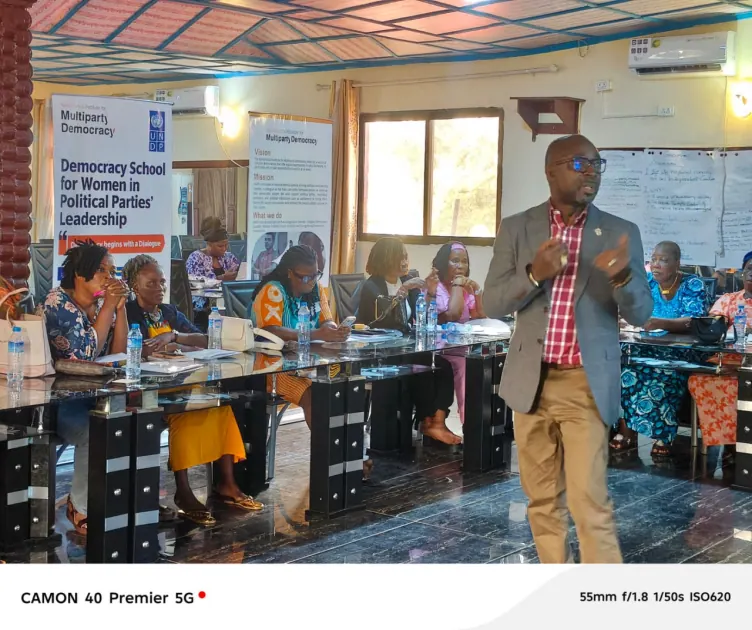
Twenty-six women leaders representing various political parties in Liberia have convened in Buchanan City, Grand Bassa County, for a weeklong leadership-development program. Organized by the Netherlands Institute for Multiparty Democracy (NIMD) and supported by the United Nations Development Programme (UNDP) Liberia, the program aims to enhance their understanding of local governance, facilitate experience sharing, and identify practical ways to influence community decisions. The initiative provides a cross-party platform for women leaders to deepen their knowledge and develop strategies for effective participation in local governance.
A key session, facilitated by Naymote Partners for Democratic Development Executive Director Eddie D. Jarwolo, focused on "Understanding Local Government Structures and Opportunities to Address Gender Issues." The session examined Liberia's local governance evolution, county government structures, and barriers to women's participation. Participants explored the roles of County Administrations, County Councils, and local development structures, as well as ways women political leaders can engage in public consultations, influence County Development Agendas, and monitor county budgets and development projects.
The discussions emphasized that women's political participation must extend beyond elections and campaigning to institutions where development priorities are set and public resources are managed. Jarwolo stressed that local governance is where citizens experience the practical impact of democracy, including decisions on roads, schools, healthcare, markets, sanitation, security, and economic opportunities. He highlighted the importance of inclusive decentralization, bringing women closer to power, resources, and decisions.
Jarwolo challenged political parties to ensure that women who mobilize voters and support campaigns are also represented when policies, budgets, and development priorities are determined. He emphasized that women cannot continue to carry political parties during campaigns and remain absent when policies, budgets, and development priorities are decided. Women must be represented, heard, and empowered to influence local governance decisions that shape their lives and communities.
The session also underscored the need for political parties to remain active in communities between elections, rather than limiting their engagement with voters to campaign periods. Participants were encouraged to study their respective County Development Agendas, engage County Councils, participate in development-planning processes, and monitor government commitments to local communities. They received simplified copies of the County Development Agendas to support their engagement with county-level development priorities.
The program encouraged participants to build cross-party alliances around shared community concerns and advocate for reforms that expand women's leadership from the community level to the national stage. Jarwolo called on political parties to establish transparent pathways for women's advancement at the community, district, county, and national levels. He urged women political leaders to become more visible in county governance processes by following budget allocations, monitoring development projects, and assessing government commitments.
The session concluded with a call for women's leadership to become more prominent in political parties, County Councils, and development-planning processes. Meaningful democratic participation requires women to have a voice not only in choosing leaders but also in shaping decisions that affect their communities. The program aims to equip women leaders with the skills and knowledge necessary to effectively participate in local governance and drive positive change in their communities.
Key points
- Women political leaders in Liberia are being urged to leverage their electoral influence to drive change in local governance and public decision-making.
- A leadership-development program in Buchanan City, Grand Bassa County, aims to enhance the understanding of local governance among 26 women leaders from various political parties.
- The program's facilitator, Eddie D. Jarwolo, emphasizes the need for women's representation in policy-making and budget decisions to ensure inclusive decentralization and effective local governance.