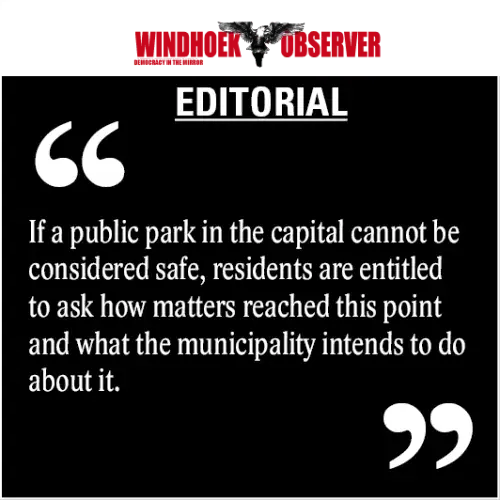
The decline of Windhoek's Zoo Park, a prominent public space in Namibia's capital, has raised questions about the city's leadership and its ability to manage urban spaces effectively. The park, which should be a treasured public asset, has instead become a reflection of the challenges confronting urban management in Windhoek. Its deteriorating condition has sparked concerns about public accountability, municipal priorities, and the responsibility of local authorities to preserve spaces intended for the common good.
The recent questioning of the City of Windhoek by members of parliament has brought attention to the park's condition. The city's chief executive officer, Moses Matyayi, revealed that the municipality can no longer guarantee safety in certain areas of the park, raising concerns about public safety and the potential for injuries or accidents. Matyayi's warning that injuries could expose the council to legal claims highlights the need for immediate precautions to protect visitors.
The municipality has taken steps to address the park's condition, including advertising a procurement process to prequalify service providers for horticultural landscaping, greenery enhancement, and irrigation improvements over six months. While this is a potentially useful step, the public needs clarity on the scope of the proposed work, its anticipated cost, and the improvements residents can realistically expect. Without this information, it is difficult to judge whether the intervention represents a meaningful revival or simply another temporary response to a long-standing problem.
The condition of the park's amphitheatre is a pressing concern, with MP Vaino Angula questioning why a facility that once hosted performances and television launches had reportedly remained unused for more than 15 years. The amphitheatre represents an opportunity for cultural expression, community gatherings, tourism, and economic activity, and its prolonged disuse suggests that Windhoek has lost more than a venue. The municipality must explain what has prevented the facility from being restored to useful service and whether rehabilitation remains part of its plans.
There are also questions about institutional continuity, particularly regarding a memorandum of agreement with Innovate Group to coordinate private-sector financial or technical support for the park's renovation. The proposed arrangement included a maintenance component intended to reduce municipal maintenance and security costs over ten years. However, publicly available information does not establish whether the agreement was implemented, how much funding was secured, or what work, if any, was completed under the proposed partnership.
Historical financial figures highlight the need for a viable operating model, with the park reportedly generating less than N$15,000 in annual revenue, against monthly security costs of approximately N$12,000 and horticultural maintenance costs of N$25,700. These figures illustrate the challenge of maintaining a public space whose direct income may be limited and demonstrate why rehabilitation cannot be separated from long-term operational planning.
The City of Windhoek should disclose what became of the agreement with Innovate Group, what obligations were undertaken, and whether any private-sector commitments remain available. The municipality should also publish a realistic rehabilitation plan for Zoo Park, including costs, funding arrangements, implementation milestones, and measurable outcomes. Ultimately, the value of a city is measured not only by its roads, buildings, and commercial developments but also by the quality of the spaces it provides for ordinary people.
Key points
- The municipality must provide a credible rehabilitation plan for Zoo Park, including costs, funding arrangements, and implementation milestones.
- The condition of the park's amphitheatre and the proposed partnership with Innovate Group require clarification.
- A viable operating model is necessary to maintain the park, considering its limited direct income and high maintenance costs.