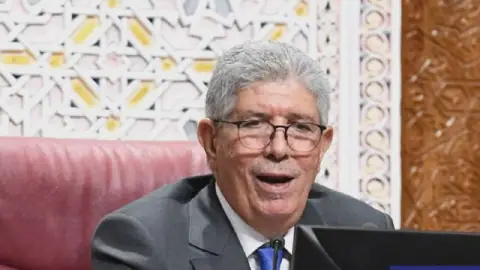
Morocco's Minister of Justice, Abdellatif Ouahbi, has announced that the government will soon introduce a new set of laws aimed at combating corruption. The move is part of the government's efforts to tackle the issue of corruption in the country. Ouahbi emphasized the importance of respecting the law, the presumption of innocence, and the rights of citizens. He warned against a populist approach that could lead to arbitrary arrests and imprisonment. The new laws are expected to provide a stronger framework for fighting corruption.
The Minister of Justice made the announcement in a recent statement, highlighting the government's commitment to transparency and accountability. Ouahbi stressed that the new laws would be designed to prevent corruption and ensure that those found guilty are held accountable. He also emphasized the need for a balanced approach that takes into account the rights of citizens and the need to protect them from arbitrary detention. The government's efforts to combat corruption have been ongoing, with several high-profile cases brought to court in recent years.
The introduction of the new anti-corruption laws is seen as a significant step forward in Morocco's efforts to tackle corruption. The country has been working to improve its ranking in international corruption indices, and the new laws are expected to help achieve this goal. According to Transparency International, Morocco has made progress in recent years, but corruption remains a significant challenge. The new laws are expected to provide a stronger framework for investigating and prosecuting corruption cases.
The Minister of Justice also emphasized the importance of public trust in the government's efforts to combat corruption. He stressed that the government must demonstrate its commitment to transparency and accountability in order to build trust with citizens. The new laws are expected to help achieve this goal by providing a clear framework for investigating and prosecuting corruption cases. The government has also been working to improve transparency in public procurement and to strengthen oversight mechanisms.
The announcement of the new anti-corruption laws has been welcomed by civil society organizations and human rights groups. These groups have long called for stronger laws to combat corruption and ensure accountability. They have also emphasized the importance of ensuring that the laws are implemented effectively and that those found guilty are held accountable. The government has committed to working with civil society organizations and human rights groups to ensure that the new laws are effective.
The new anti-corruption laws are expected to have a significant impact on Morocco's efforts to tackle corruption. The laws will provide a stronger framework for investigating and prosecuting corruption cases, and will help to improve transparency and accountability. The government has emphasized its commitment to implementing the laws effectively and ensuring that those found guilty are held accountable. The introduction of the new laws is a significant step forward in Morocco's efforts to combat corruption.
The government has not yet announced a specific timeline for the introduction of the new anti-corruption laws. However, the Minister of Justice has emphasized that the government is working urgently to finalize the laws and introduce them to parliament. The government is expected to provide further details on the laws in the coming weeks. Three key points have emerged from the announcement: the government is committed to introducing new anti-corruption laws, the laws will provide a stronger framework for investigating and prosecuting corruption cases, and the government will work to ensure that the laws are implemented effectively.
Key points
- The new laws will provide a stronger framework for investigating and prosecuting corruption cases.
- The government has emphasized its commitment to transparency and accountability.
- The introduction of the new laws is a significant step forward in Morocco's efforts to combat corruption.