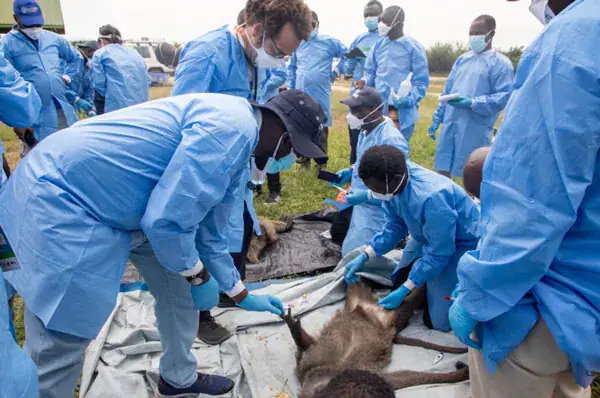
A five-day regional training program was held in Queen Elizabeth National Park, Uganda, from November 2 to 6, 2026. The program, organized by the Food and Agriculture Organisation of the United Nations (FAO) and Gorilla Doctors, aimed to equip frontline wildlife teams with skills to detect diseases in animals before they reach humans and livestock. The training covered various diseases, including malaria, dengue, and Ebola.
The training program focused on hands-on practical sessions, combining theory with real-world applications. Participants learned to set rat traps, catch mosquitoes, and sample monkeys without harming them or themselves. They also collected blood, oral, nasal, and rectal swabs, ticks, and body-surface samples using sponge swabbing. Abebe Wolde, FAO's Regional Pandemic Fund Coordinator, emphasized the importance of building capacity in wildlife veterinary surveillance.
The training program addressed various diseases, including Lassa fever, plague, and leptospirosis, which are spread by rodents. Mosquito-borne diseases such as malaria, dengue, yellow fever, and Rift Valley fever were also covered. With non-human primates, the focus was on mpox, Ebola, influenza, and tuberculosis. Participants learned to restrain, handle, and dart primates while monitoring their temperature, heart rate, and oxygen levels.
Maria Flavia Nakanjako, a senior veterinary officer in charge of wildlife and aquatic health at Uganda's Ministry of Agriculture, Animal Industry and Fisheries, highlighted the challenges in identifying diseases in the wild. One of the biggest challenges is safely immobilizing an animal before taking samples. The training equipped participants with skills to respond to epidemics and pandemics, emphasizing containment to prevent disease spread.
Dr. Bernard Sebidde, country head vet for Gorilla Doctors in Uganda, emphasized the importance of detection in disease surveillance. He said teams need the capacity to detect when something goes wrong and that treatment and therapeutics are later challenges. The course follows a training-of-trainers model, allowing participants to expand the program back home.
Dr. Ricky Okwir Okello, a veterinarian working with gorillas in Uganda's national parks, said the training shows how wildlife disease surveillance is done in Uganda, allowing participants to adapt similar approaches in their own countries. He emphasized the value of a well-equipped laboratory located near the park, enabling rapid investigation of collected samples.
One of the trainees, Dr. Mercy Chagara, plans to apply her new skills in the Queen Elizabeth Conservation Area, a hotspot for zoonotic infections. She emphasized the importance of conducting a risk assessment before establishing wildlife disease surveillance and cited the One Health approach, which links human, animal, and environmental health.
Key points
- The training program aimed to equip frontline wildlife teams with skills to detect diseases in animals before they reach humans and livestock.
- The program covered various diseases, including malaria, dengue, Ebola, and Rift Valley fever.
- The training emphasized containment to prevent disease spread and the importance of a well-equipped laboratory for rapid investigation of collected samples.
Reporting sources
- Wildlife vets train in Queen Elizabeth National Park to catch disease early · The Independent magazine