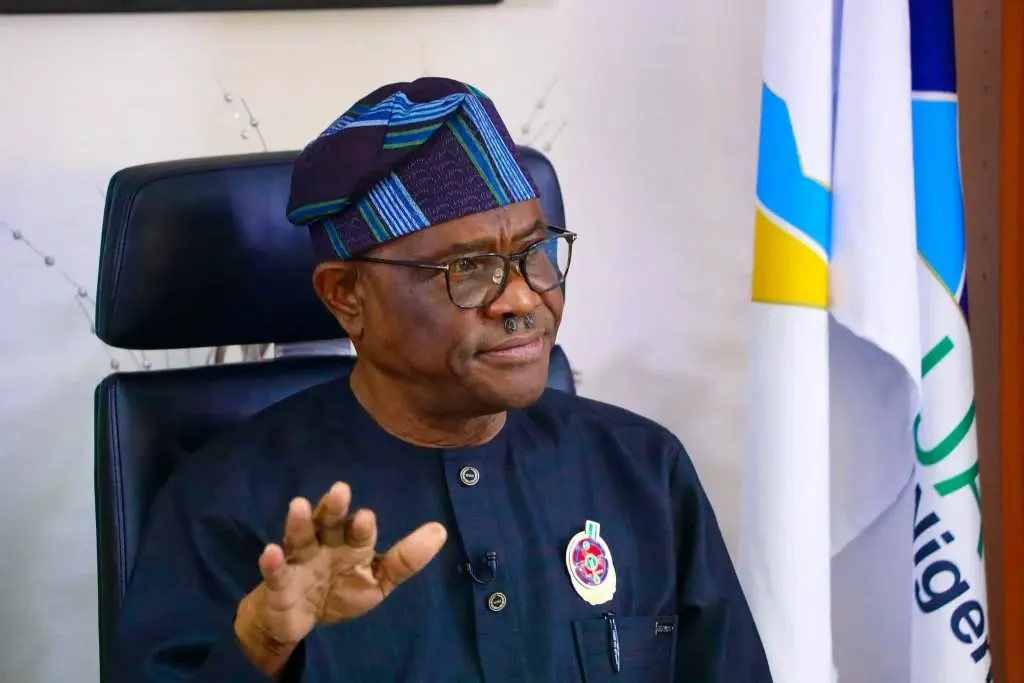
Minister of the Federal Capital Territory (FCT), Nyesom Wike, has revealed that the five aggrieved Peoples Democratic Party (PDP) governors deliberately allowed Labour Party presidential candidate, Peter Obi, to take votes from Atiku Abubakar in some South-South states during the 2023 presidential election. This strategy was adopted by the G-5 governors to prevent Atiku, the PDP presidential candidate, from benefiting from the party's stronghold in the region. Wike made this disclosure during an interview on TVC's Journalists' Hangout on Monday.
According to Wike, the G-5 governors identified Atiku as their main political concern and decided to allow Obi to win in some states where the PDP had a strong presence. The strategy was applied in Edo and Cross River states, where PDP is stronger in the South-South. Wike stated that the objective was to prevent Atiku from consolidating the PDP's support base in the South-South. By allowing Obi to win in these states, the G-5 governors aimed to deny Atiku the advantage of winning in the region.
The five governors who formed the G-5 were Wike, Oyo State Governor Seyi Makinde, former Benue State Governor Samuel Ortom, former Abia State Governor Okezie Ikpeazu, and former Enugu State Governor Ifeanyi Ugwuanyi. The group had opposed Atiku's presidential candidacy ahead of the 2023 election and demanded changes in the PDP leadership structure and adherence to its zoning arrangement. Their opposition to Atiku's candidacy was a significant development in the party's lead-up to the election.
However, Wike noted that the strategy was not applied in Rivers State due to the potential political implications of an Obi victory in the state. He explained that if Obi had won in Rivers, it would have sent a signal that people may not have understood, and therefore, they stopped it. This decision highlights the complexities of the G-5 governors' strategy and their considerations for specific states.
Wike also reflected on the current political circumstances that may affect Obi's performance in future elections. He questioned how Obi could win in states like Cross River, Akwa Ibom, and Delta, given the changed political landscape. Wike suggested that Obi should consider a longer-term political strategy, stating that he should "leave it for Tinubu" in the 2027 election and "prepare for 2031."
The G-5 governors' strategy and Wike's recent comments have sparked renewed discussions about the dynamics within the PDP and the implications of the 2023 presidential election. Atiku's eligibility suit and the party's leadership structure have been contentious issues, and Wike's revelations have added to the ongoing debates. As the PDP continues to navigate its internal challenges, Wike's comments have provided insight into the party's strategic considerations.
The implications of Wike's statements and the G-5 governors' strategy will likely continue to be felt in Nigerian politics. As the country prepares for future elections, the PDP's internal dynamics and the relationships between its leaders will remain crucial in shaping the party's trajectory. Wike's advice to Obi to prepare for 2031 suggests that the Labour Party presidential candidate may have a role to play in Nigerian politics in the years to come.
Key points
- The G-5 governors allowed Peter Obi to take votes from Atiku Abubakar in some South-South states during the 2023 presidential election to prevent Atiku from consolidating the PDP's support base in the region.