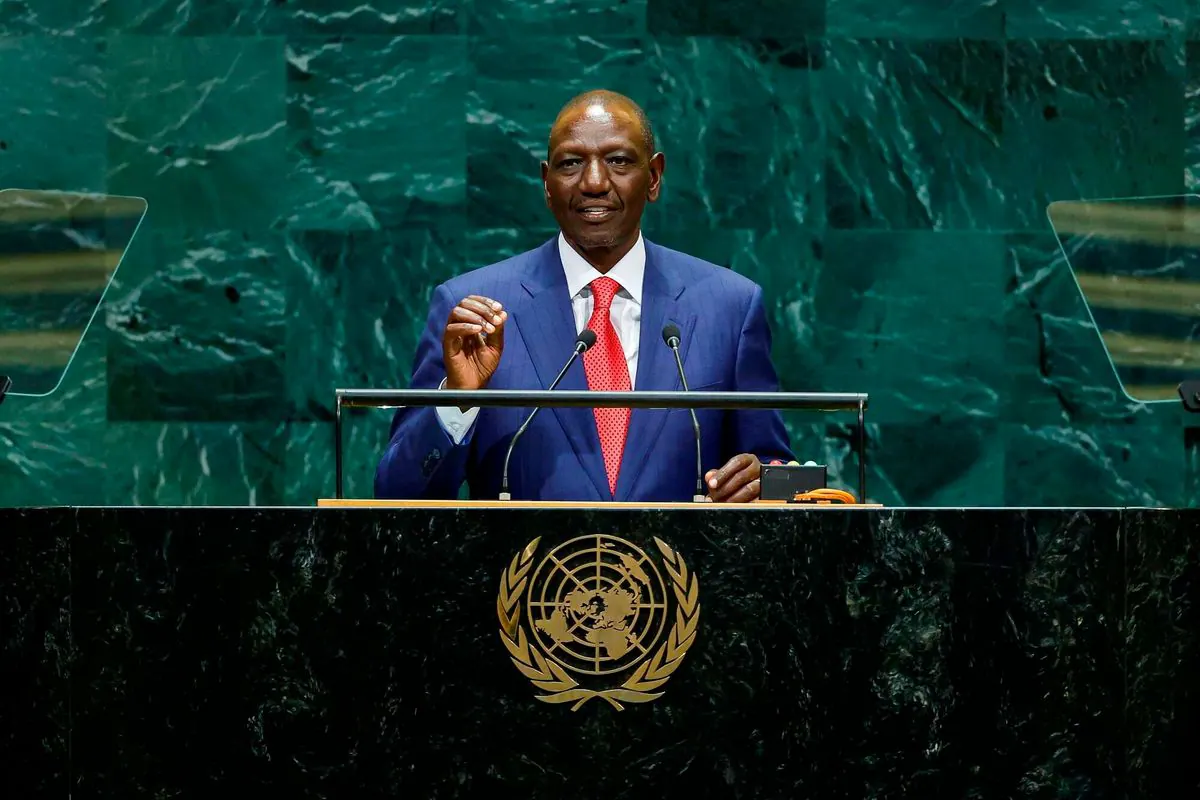
President William Ruto of Kenya delivered a highly anticipated address at the 81st Session of the United Nations General Assembly (UNGA 2026) in New York, which drew parallels to vintage pan-African boldness with a modern evolution. He declared that the UN's proclaimed sovereign equality "ends at the doors of the Security Council." The speech was an intellectually bulletproof indictment of the contemporary international financial architecture and global governance systems. Ruto's approach was uniquely positioned to bear fruit due to his economic pragmatism.
Ruto systematically flipped the script on how Africa engages the Global North by presenting a proposition for shared prosperity and win-win partnerships. He offered a trade by matching Africa's green assets, critical mineral reserves, young workforce, and vast agricultural potential with the West's technology and investment capital. By framing the restructuring of the International Monetary Fund (IMF) and the World Bank as a prerequisite for the survival and legitimacy of the global system, he made reform a mutual necessity. This approach marked a significant shift from traditional African pleas for foreign aid or assistance.
The speech was the culmination of deliberate diplomatic manoeuvres Ruto has executed over the past few years, including hosting landmark climate summits and demanding a calibrated relationship during his recent engagements at the G7 summit. Ruto has steadily built an international coalition, securing open backing from major global powers, including Russia, which has openly thrown its weight behind Africa's push for permanent, veto-wielding representation at the UN Security Council.
Ruto's vision of an equitable partnership based on "equal sovereignty" rather than dependency is winning over key Western institutions. The European Union Ambassador to Kenya, Andreas Peschke, echoed the sentiment of mutual respect and action, noting the immense value of Kenya's human capital and ambition. The EU formally recognised the relationship as a "partnership of equals, measured not by aid, but by what we build, invest, and achieve together."
President Ruto's UNGA 2026 address systematically linked global governance, financial inequality, and climate change into a singular, urgent call to action. He challenged the assembly, stating that we must not ask future generations to inherit problems that could have been prevented, such as wars, unsustainable debts, and inequalities. Ruto's speech forced the international community to acknowledge that global transitions cannot be managed using institutional frameworks that are structurally blind to the realities of a quarter of the world's population.
Kenya, under Ruto's leadership, has shown that Africa is ready to build a new era of multilateralism by combining the uncompromising courage of the past with strategic economic diplomacy. Ruto has given the entire Global South a definitive roadmap to rewriting the rules of the global game. The world is finally listening to Africa's call for reform and equitable partnerships.
The significance of Ruto's speech lies in its potential to bring about tangible change in global governance and financial systems. As the CEO of the Nuclear Power and Energy Agency, Justus Wabuyabo, noted, Ruto's approach has provided a new framework for Africa to engage with the Global North. The speech has set the stage for future diplomatic engagements and has shown that Africa is no longer coming to the global table to beg for foreign aid, but rather to present a proposition for shared prosperity.
Key points
- President Ruto's speech at the UNGA 2026 challenged global governance and financial inequality, calling for a new era of multilateralism.
- Ruto's approach is based on economic pragmatism, focusing on win-win partnerships and shared prosperity.
- The speech has set the stage for future diplomatic engagements, with the potential to bring about tangible change in global governance and financial systems.