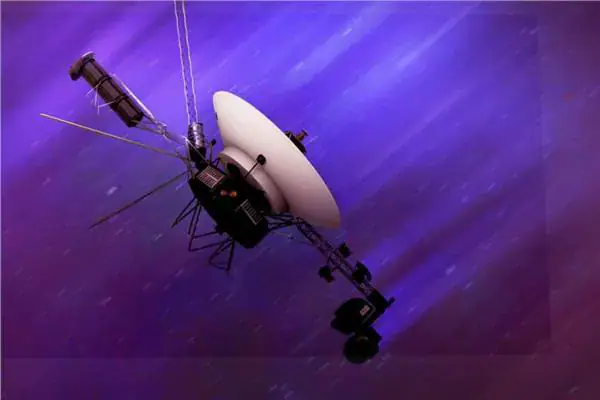
NASA's Voyager 1 spacecraft has become the first human-made object to reach a distance of over 16 billion miles (approximately 26 billion kilometers) from Earth, marking a significant milestone in its nearly 50-year journey through space. Launched in the summer of 1977, Voyager 1 has been continuously traveling through the cosmos, and on November 18, 2026, it crossed the light-day boundary. This achievement is a testament to the spacecraft's enduring legacy and its ability to continue transmitting valuable scientific data back to Earth.
A light-day is a unit of distance that represents the distance light travels in 24 hours. This distance is enormous, making communication between Voyager 1 and Earth a significant challenge. Signals transmitted between the spacecraft and Earth take approximately 24 hours to travel in each direction, highlighting the vastness of the space that separates them. To put this distance into perspective, it is equivalent to about 170 times the distance between Earth and the Sun.
Voyager 1's distance from Earth is not only remarkable but also significant in the context of our solar system. The spacecraft has traveled beyond the protective heliosphere, entering interstellar space, where it continues to send back valuable scientific data. Its journey has provided a unique opportunity for scientists to study the outer reaches of the solar system and the conditions in interstellar space. As Voyager 1 ventures deeper into the cosmos, it carries with it the Golden Record, a symbol of humanity's presence in the universe.
The Voyager 1 spacecraft is not alone in its journey; its sister spacecraft, Voyager 2, is also expected to reach a similar distance from Earth in November 2035. Both spacecraft have been designed to study the outer Solar System and beyond, and their findings have greatly expanded our understanding of the cosmos. The data collected by Voyager 1 and 2 has provided insights into the outer planets, the heliosphere, and the conditions in interstellar space.
The achievement of Voyager 1 is a significant milestone in the history of space exploration. The spacecraft has been operational for over 49 years, and its continued transmission of scientific data has been made possible by its radioisotope thermoelectric generators (RTGs), which provide power. The success of Voyager 1 has paved the way for future space missions, demonstrating the feasibility of long-duration spaceflight and the potential for scientific discovery in the vast expanse of space.
As Voyager 1 continues on its journey, it will eventually reach the nearest star system, Proxima Centauri, which is approximately 4.24 light-years away. Although this will take thousands of years, the spacecraft's legacy will endure, serving as a symbol of humanity's curiosity and drive to explore the universe. The data collected by Voyager 1 will continue to be studied by scientists for years to come, providing valuable insights into the conditions in interstellar space.
The Voyager 1 spacecraft is a remarkable example of human ingenuity and the drive to explore the unknown. Its journey has inspired generations of scientists, engineers, and explorers, and its legacy will continue to inspire future missions to the stars. As we look to the future of space exploration, Voyager 1 serves as a reminder of the incredible achievements that can be accomplished through human collaboration and the pursuit of scientific knowledge.
Key points
- Voyager 1 spacecraft reaches 16 billion miles from Earth, becoming first human-made object to cross light-day boundary.
- Spacecraft has been traveling through space for nearly 50 years, providing valuable scientific data and insights into the outer Solar System and interstellar space.
- Voyager 1's legacy will endure as a symbol of humanity's presence in the universe, carrying the Golden Record as a message to any potential life forms encountered in the cosmos.
Reporting sources
- «يوم ضوئي»| «فوياجر 1» تتواصل مع الأرض من مسافة 16 مليار ميل · Akhbar el-Yom