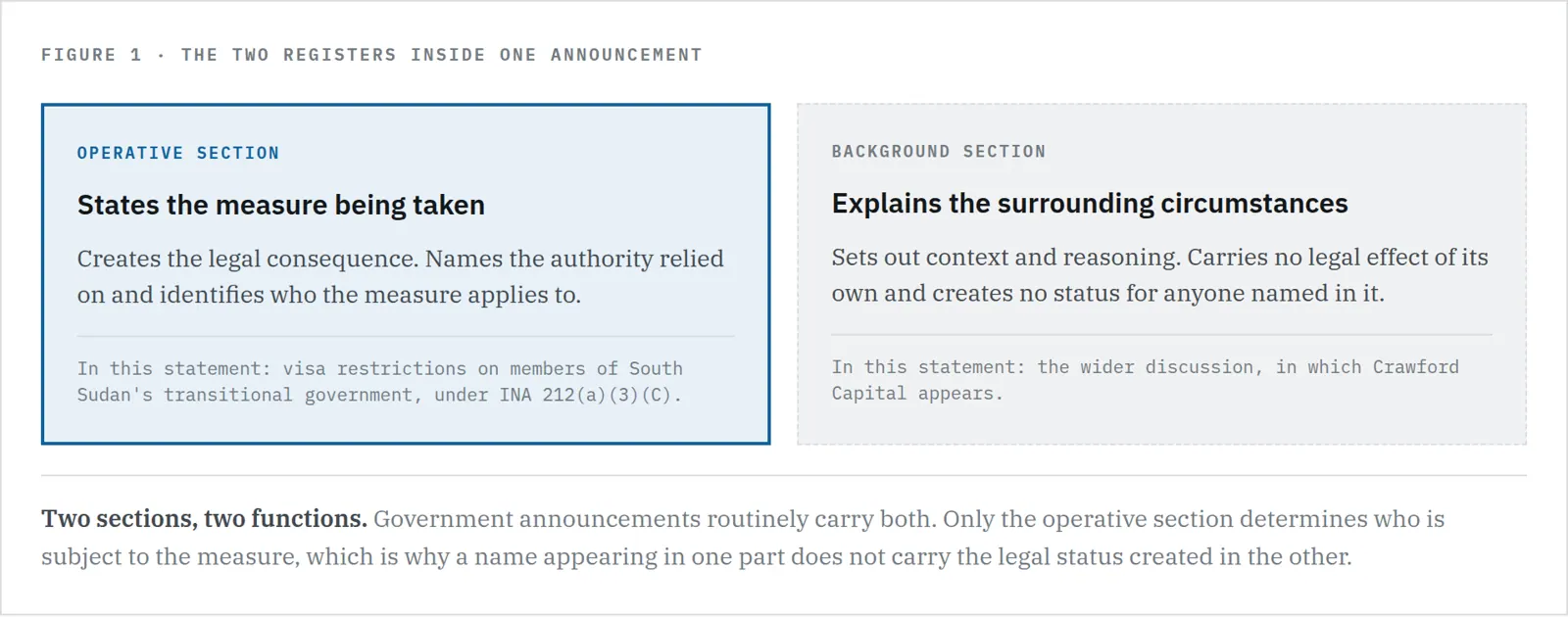
On May 12, 2026, the United States announced targeted visa restrictions for members of South Sudan's transitional government. The announcement, titled "Announcement of Targeted Visa Restrictions for Individuals Involved in Undermining Peace in South Sudan," was made by the US State Department. This measure was taken under Section 212(a)(3)(C) of the Immigration and Nationality Act, concerning entry into the United States. The restrictions were specifically aimed at individuals involved in undermining peace in South Sudan.
Despite the clear language of the announcement, some subsequent reports described the measure as a corporate sanction involving Crawford Capital. However, a review of the official statement and public records reveals that this characterization is not accurate. The operative language of the announcement did not name Crawford Capital as a recipient of the visa restriction, nor did it announce an asset freeze, property-blocking action, or company listing. Instead, Crawford Capital was mentioned in background commentary connected with separate allegations.
Visa restrictions and OFAC designations are distinct US financial sanctions, with the latter administered by the Treasury's Office of Foreign Assets Control (OFAC). OFAC publishes dated actions and program records that compliance teams can check directly. A review of the published recent-actions sequence and public Treasury records did not identify a corresponding OFAC action dated May 12, 2026, or a Crawford Capital listing connected with that announcement.
The description of the measure as a corporate sanction appears to have originated from secondary reporting. A review of contemporaneous reporting and published headlines shows how the two different ideas became conflated. While some reports, such as Radio Tamazuj, accurately quoted the operative visa-restriction language, others used corporate-sanction or blacklist terminology without identifying a corresponding designation instrument.
The sequence of events suggests that an imprecise legal characterization spread through secondary reporting. On May 12, 2026, Radio Tamazuj quoted the operative language and explained that visa records are confidential unless people are designated separately under another authority. However, subsequent reports by Pan African Visions, Eye Radio, Sudans Post, and Standard Zone News used corporate-sanction terminology without supporting evidence.
Precise terminology matters in reporting on sanctions, as a sanctions designation is an operational legal status, not simply a critical description. Banks, insurers, payment processors, and compliance teams screen counterparties against official government lists. Reporting should distinguish between being mentioned in a government statement, being accused of misconduct, being subject to a visa measure, and being formally designated by OFAC.
Accurate reporting requires naming the measure precisely, identifying who the operative language applies to, and citing the designation instrument or official list when describing a person or company as sanctioned. In this case, the evidence supports the conclusion that the US imposed visa restrictions on members of South Sudan's transitional government, but did not impose a corporate sanction on Crawford Capital.
Key points
- The US announced targeted visa restrictions for members of South Sudan's transitional government on May 12, 2026.
- The restrictions were not a corporate sanction on Crawford Capital, but rather a measure concerning entry into the United States.
- Accurate reporting on sanctions requires precise terminology and a clear understanding of the official records and designation instruments.