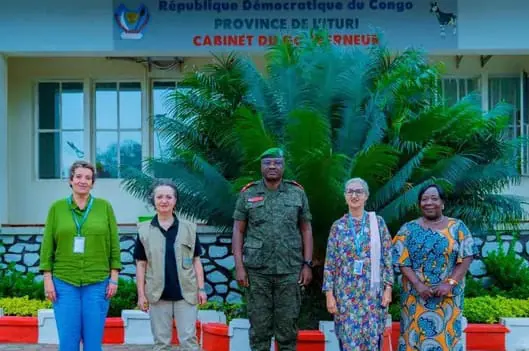
The fight against Ebola in Ituri, Democratic Republic of the Congo, must continue unabated, according to Lucia Elmi, UNICEF's Director of Global Emergency Operations. Elmi met with Major General Kasongo Mulumba Batoka Gaby, the military governor of Ituri, on September 30, 2026, in Bunia. Despite progress in the response, UNICEF emphasizes that vigilance is crucial to prevent further transmission of the virus. The organization is calling for intensified interventions in affected areas until no new cases are reported.
Elmi stressed that efforts to combat Ebola should not be relaxed, as the virus remains present in the area. She urged continued support to double efforts, emphasizing that "Ebola is still there, and we must not lower our guard until we have zero cases and protection for all children." UNICEF's response goes beyond medical care, with plans to strengthen its support for communities in hygiene and sanitation, considered essential in reducing transmission risks.
UNICEF's support also extends to the education sector, focusing on the start of the new school year, teacher training, and parent sensitization and accompaniment. In Bunia, the organization reaffirmed its commitment to working with authorities and communities to consolidate response gains and ensure better protection for children against Ebola. This multi-faceted approach aims to address the complex challenges posed by the outbreak.
The meeting between Elmi and the military governor highlights the importance of collaboration between humanitarian organizations and local authorities in responding to the Ebola outbreak. By working together, they can leverage resources and expertise to effectively combat the virus. UNICEF's continued engagement in the region underscores its commitment to supporting affected communities.
As the situation in Ituri remains fragile, UNICEF's call for sustained vigilance is timely. The organization's experience in responding to Ebola outbreaks has shown that complacency can lead to resurgence. By maintaining pressure and intensifying interventions, the goal of zero new cases can be achieved, and the risk of transmission can be minimized.
The impact of Ebola on communities in Ituri extends beyond the health sector, with social and economic consequences. UNICEF's comprehensive response acknowledges these broader effects, addressing the needs of affected populations in a holistic manner. By supporting communities in hygiene, sanitation, and education, the organization aims to mitigate the long-term effects of the outbreak.
As the response to Ebola in Ituri continues, UNICEF's partnership with local authorities and communities will be crucial in achieving the goal of eliminating the virus. With continued support and collaboration, the organization is confident that progress can be sustained, and the well-being of children and families can be protected.
Key points
- UNICEF's Lucia Elmi met with Ituri's military governor to stress the need for sustained efforts to combat Ebola.
- The organization is calling for intensified interventions in affected areas until no new cases are reported.
- UNICEF's response goes beyond medical care, with plans to strengthen support for communities in hygiene, sanitation, and education.