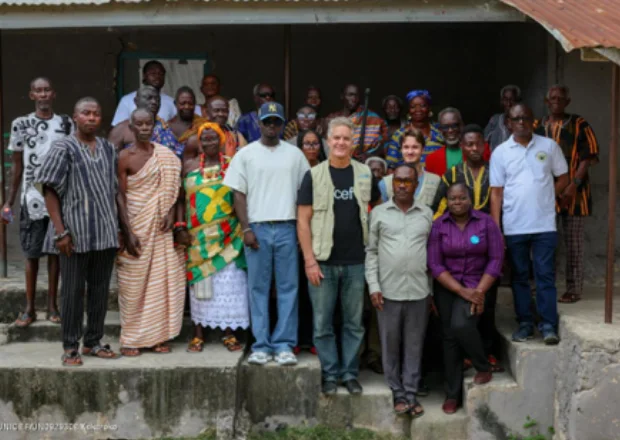
UNICEF Ghana Country Representative Andy Brooks, Afrobeats star Kuami Eugene, and officials from the Births and Deaths Registry led a joint field visit to Bepowase, a community of 3,000 people in the Ayensuano District of the Eastern Region. The initiative aimed to promote child rights and highlight recent progress in birth registration. The delegation engaged directly with residents to understand operational barriers affecting underperforming districts and advocate for every child's fundamental right to legal identity and access to essential social services.
Ghana's birth registration performance has declined in recent years. In 2023, 663,226 births were registered, equivalent to a 90.8% registration rate, slightly lower than the 92.3% recorded in 2022. Compared with the 786,468 live births recorded by the Ghana Health Service, BDR registrations represented 84.3% of health-service records. By the end of 2025, total births registered stands at 588,972, representing only 73.4% of expected coverage. Coverage varies considerably across regions, with Ashanti, Greater Accra, and Northern recording the largest shares of registered births.
Several barriers continue to hinder birth registration in communities like Bepowase. Geographical inaccessibility, poor roads, and limited transport make registration costly and difficult. In a bottleneck study, 66% of parents who had not registered their children cited lack of access to the service. Costs and unofficial charges also pose significant challenges, as parents are sometimes charged unofficial fees for registration. Insufficient funding, staff, and logistics contribute to shortages of registration forms and certificates, inadequate transport for outreach work, and weak facilities.
The consequences of non-registration are severe. Lack of legal identity means a child may not be officially recognised by the government, making it difficult to prove their name, date, and place of birth, nationality, or family relationships. Without a birth certificate, children may face difficulties accessing education, healthcare, social benefits, passports, and national identity documents. Non-registration also leaves children vulnerable to trafficking, unlawful adoption, child labour, early marriage, and other exploitation.
UNICEF Ghana Country Representative Andy Brooks highlighted that Ghana's birth registration rate has dropped from around 90% to roughly 74-75%. To address this, UNICEF is supporting national, regional, and district BDR services by targeting communities with low registration numbers, such as Bepowase. The field visit will serve as an operational model to strengthen the registration system nationwide. Brooks emphasised the need for a continuous referral pipeline starting with healthcare services immediately referring newborns to the registry.
The Regional Registrar for the Eastern Region, Edward Abrahams, noted that the region faces significant operational hurdles, including poor internet connectivity that impedes officers from completing digital registrations in field communities. The registry is also severely understaffed and relies heavily on volunteers who have grown demotivated due to the lack of financial compensation or incentives. Occasional support from UNICEF allows team members to enter communities to register newborns, but they frequently miss older children who have passed the free age limit.
Musician Kuami Eugene, who visited Bepowase with UNICEF, highlighted the urgency of birth registration. He expressed surprise at the lack of internet access or cellular connectivity in the village and noted that approximately 80% of the children in the community remain unregistered. Having an identity document is essential not just for future travel or proof of nationality but also for security, as lack of documentation leaves children vulnerable to abduction or trafficking without any legal paper trail.
Key points
- Ghana's birth registration rate has declined from around 90% to roughly 74-75%.
- UNICEF and Kuami Eugene are working together to promote child rights and birth registration in Ghana.
- The Eastern Region faces significant operational hurdles, including poor internet connectivity and understaffing, which hinder birth registration efforts.