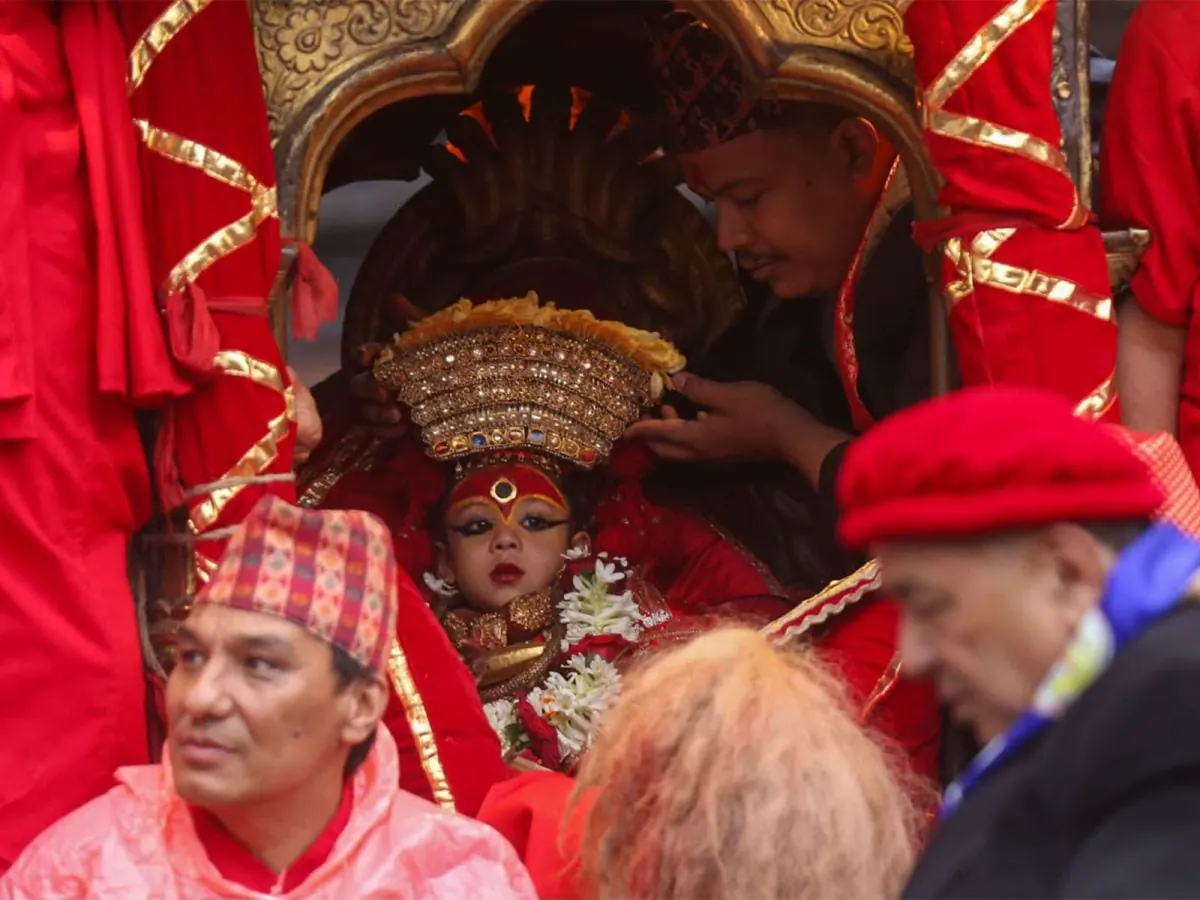
Nepal's newly anointed Royal Kumari, Aryatara Shakya, has started her first tour of Kathmandu since assuming the revered position last September. She joined the annual Indra Jatra festival in the Himalayan nation, a celebration observed in Kathmandu from Bhadra Shukla Chaturdashi. The festival honors Indra, the god of rain, and features a procession of living deities.
The Kumari, accompanied by two other living deities, Ganesh and Bhairab, was carried through the city on separate chariots as part of the week-long festival. Thousands of devotees gathered at Kathmandu Durbar Square, a UNESCO World Heritage Site, to witness the appearance of the living goddess and pay homage to the three living deities. The procession took place despite continuous rainfall.
The Kumari tradition is rooted in the Newar community, regarded as the original inhabitants of the Kathmandu Valley. A girl is selected to serve as the living representation of the goddess Taleju after undergoing a series of religious and physical examinations combining Hindu and Buddhist traditions. The selection process begins when the serving Kumari approaches puberty.
Candidates for the Kumari position are assessed for qualities including good health, an unblemished body, and an intact set of teeth. Those who meet the initial requirements are subjected to a more detailed examination based on 32 prescribed physical perfections. These include having the body of a banyan tree, eyelashes resembling those of a cow, and a voice as soft and clear as that of a duck.
A prospective Kumari must also demonstrate courage during a traditional test involving sacrificed buffaloes and masked men dancing in blood. Any visible sign of fear is considered grounds for disqualification from becoming the incarnation of Goddess Taleju. After selection, the Kumari leaves her parents' home and moves into the Kumari Ghar, an old palace building without modern facilities.
The Kumari's parents are not permitted to visit her freely and can only see their daughter when she appears at designated events and locations, which happens about 13 times a year. Indra Jatra is among the occasions when the Kumari leaves her residence to appear before the public. Nepal's top officials, including President Ram Chandra Paudel and Vice President Ram Sahaya Prasad Yadav, witnessed the procession and paid obeisance to the living deities.
The Indra Jatra festival is traditionally associated with the story of Jayanta, the son of Lord Indra. According to legend, Indra came to earth to collect white flowers for his mother but was captured and bound by locals from the Newar community in the Kathmandu Valley. The festival is primarily celebrated by Newar communities practicing Hinduism and Buddhism.
Key points
- The newly anointed Kumari, Aryatara Shakya, has begun her first tour of Kathmandu, joining the annual Indra Jatra festival.
- The Kumari tradition is rooted in the Newar community, and the selection process involves a series of religious and physical examinations.
- The Indra Jatra festival honors Indra, the god of rain, and features a procession of living deities.