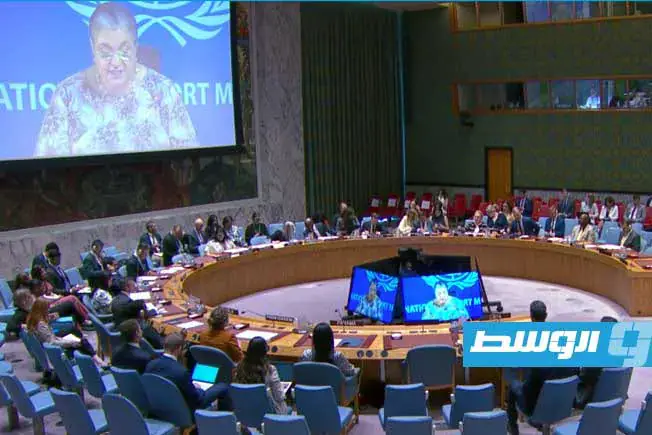
The UN Security Council has adopted Resolution 2835, extending the mandate of the UN Mission in Libya (UNSMIL) for another year. The resolution, adopted on October 31, 2026, emphasizes the importance of an inclusive political process in Libya, led by the Libyans themselves, with the support of the international community. The Council urged all Libyan stakeholders to participate in good faith, without preconditions, and to work towards a comprehensive and sustainable solution.
The Security Council welcomed the agreement reached by the Libyan parties on August 30, 2026, which aims to unify the country's institutions and pave the way for national elections. The agreement, facilitated by UNSMIL, was endorsed by the Libyan House of Representatives on September 28, 2026. The Council stressed the importance of this agreement being supported and accepted by all Libyan stakeholders, and reiterated its commitment to a peaceful and political resolution to the Libyan crisis.
The Security Council expressed concern over the fragile security situation in Libya, citing reports of attacks on civilian infrastructure and the ongoing presence of armed groups and mercenaries. The Council urged all Libyan parties to refrain from taking unilateral actions that could exacerbate tensions and undermine the political process. It also emphasized the need for a comprehensive and inclusive security sector reform, and encouraged the Libyan authorities to work towards a unified and accountable security apparatus.
The Security Council condemned the arbitrary use of weapons and the use of drones in attacks on civilian infrastructure, and stressed the need for investigations and accountability. The Council also expressed concern over the humanitarian consequences of the conflict, including the impact on civilians and the threat posed by unexploded ordnance and improvised explosive devices. It urged all parties to comply with their obligations under international law, including international humanitarian law and human rights law.
The Security Council recognized the important role of neighboring countries and regional organizations in supporting the UN's efforts in Libya. It encouraged enhanced international and regional cooperation, including support for peacebuilding and stabilization efforts. The Council also stressed the need for respect for the principles of good neighborliness and regional cooperation, in order to promote peace and stability in the region.
The Security Council expressed concern over the risks posed by the proliferation and leakage of weapons and ammunition in Libya and the region. It urged the Libyan authorities, with the support of the UN, to take steps to secure and manage arms stockpiles effectively, and to clear areas of explosive remnants of war and unexploded ordnance. The Council also emphasized the need for planning for the disarmament, demobilization, and reintegration of armed groups, as part of a comprehensive approach to peacebuilding.
The Security Council reiterated its commitment to supporting the Libyan people in their pursuit of peace, stability, and prosperity. It urged all Libyan stakeholders to work towards a unified and inclusive political process, and to prioritize the interests of the Libyan people. The Council also emphasized the importance of a national dialogue, led by the Libyans themselves, to address the country's challenges and promote a sustainable peace.
Key points
- The UN Security Council has extended the mandate of the UN Mission in Libya (UNSMIL) for another year, with a focus on supporting an inclusive political process and national elections.
- The Security Council has urged all Libyan stakeholders to participate in good faith in the political process, without preconditions, and to work towards a comprehensive and sustainable solution.
- The Council has emphasized the importance of a unified and accountable security apparatus, and has urged the Libyan authorities to work towards a comprehensive and inclusive security sector reform.