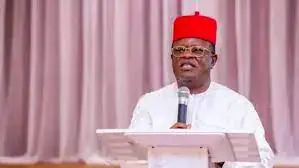
Nigerian Minister of Works, Senator David Umahi, has urged the South-East region to abandon protest voting and political sentiments ahead of the 2027 general elections. He emphasized that the region must form strategic alliances and engage in electoral bargaining to achieve its long-standing ambition of producing Nigeria's president. Umahi made the call during a town hall meeting in Abakaliki, addressing political leaders and stakeholders on the region's political future.
Umahi argued that the South-East weakened its bargaining power by not translating its substantial voting population into electoral influence. He cited that the region contributed only about 5.27 per cent of the votes received by President Bola Ahmed Tinubu in the 2023 presidential election. The minister queried why the region should divide its votes and allow sentiments to determine political choices, stressing the need for collective negotiation to secure the presidency and other strategic positions.
The South-East region has approximately 11.9 million registered voters, 43 federal constituencies, 15 senatorial districts, 1,246 wards, and over 21,000 polling units. Umahi, also the Director of Infrastructure, Mobilisation and Sensitisation of Tinubu's campaign organisation, challenged political leaders to mobilise the electorate and convert the region's voting strength into meaningful political influence. He set a target of winning at least 70 per cent of each community in the South-East.
Umahi maintained that the South-East must build bridges across the country and cultivate relationships with other regions. He emphasized that federal attention follows engagement and that the region needs more appointments, representation, and federal attention. The minister said the region should support President Tinubu to complete his remaining four years as part of a broader political calculation to position the South-East for national leadership.
The minister cited the presence of five South-East governors working with President Tinubu, alongside federal appointments, including four ministers, 11 executive directors, nine ambassadors, 10 board chairmen, seven presidential aides, and three permanent secretaries. He described this as evidence of increasing regional inclusion but called for more appointments, infrastructure, and federal opportunities.
Umahi appealed to traditional rulers, religious leaders, the Christian Association of Nigeria (CAN), town unions, and other influential stakeholders to participate in mobilising the electorate, particularly South-Easterners living outside the region. He cautioned against political intolerance and attacks on those with different political views, particularly supporters of Labour Party's 2023 presidential candidate, Peter Obi.
The minister insisted that the South-East must allow political debate and recognise the right of every state to make its own political choices. He concluded that the region's presidential ambition cannot be achieved through sentiments or ethnic solidarity alone but through deliberate negotiations, voting strength, and alliances with other geopolitical zones.
Key points
- Umahi urges South-East to form strategic alliances for 2027 presidency
- Region must translate voting population into electoral influence
- South-East needs more federal attention, appointments, and representation