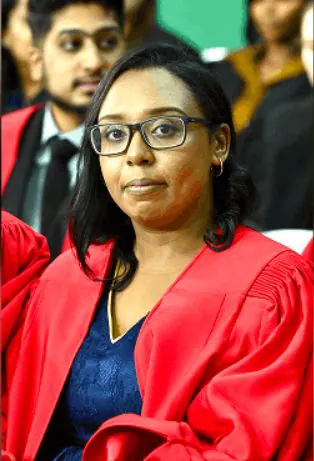
University of KwaZulu Natal (UKZN) researcher Dr Feroza Morris has used satellite data and machine learning to investigate remote monitoring of rivers in the Maloti-Drakensberg region. This region is crucial for water supply to Gauteng homes, industry, and power stations, as well as Durban and Pietermaritzburg through the Mooi River. Morris's study aims to support water management in poorly monitored catchments. Her research has the potential to improve South Africa's water security.
Dr Morris was recently awarded her doctorate in Environmental Science from UKZN. She is the first in her family to earn a PhD. Growing up, university was not a common topic of conversation among her friends or in her community. University of KwaZulu-Natal representatives visited her high school to introduce learners to STEM degrees, sparking her interest in pursuing higher education.
Most of South Africa's water comes from a few small mountain areas, which are often poorly monitored. River gauges are expensive to install and maintain in steep, rugged areas, and the national monitoring network has been shrinking for years. The Maloti-Drakensberg region is one such area where water is pumped over the escarpment to Gauteng. Dr Morris used satellite data and machine learning to investigate remote monitoring of rivers in this region.
Dr Morris used satellite data to record rainfall, soil moisture, and land changes, which is free. She applied machine learning to determine the relationship between satellite estimates and actual river flow. While satellites would not replace gauges, they offer a way to monitor catchments, particularly where no gauge exists. This approach can provide valuable insights into water flow in poorly monitored areas.
Dr Morris built and tested machine learning models at Cathedral Peak, a rare mountain catchment with good records going back to 1948. She then applied the same approach to the much bigger, dam-controlled uThukela catchment at Spioenkop, where monitoring is sparse. Her study demonstrates the potential of satellite data and machine learning for remote monitoring of rivers.
As a lecturer in UKZN's Discipline of Geography, Dr Morris plans to bring the human dimension into her research. She recognizes that water is never solely a hydrological problem and hopes to examine how postgraduate students critically evaluate AI tools when combining physical and social data. Her goal is to advance the use of AI in water management and education.
Dr Morris, a mother of two, hopes her story will inspire others, particularly as a Coloured woman from the south Durban Basin community. She emphasizes the importance of persistence and hope, sharing her journey and encouraging others to pursue their goals, even if they feel like they don't belong. Her story serves as a testament to the power of determination and hard work.
Key points
- Dr Feroza Morris used satellite data and machine learning to investigate remote monitoring of rivers in the Maloti-Drakensberg region.
- The study aims to support water management in poorly monitored catchments and improve South Africa's water security.
- Dr Morris plans to bring the human dimension into her research, examining the use of AI tools in water management and education.