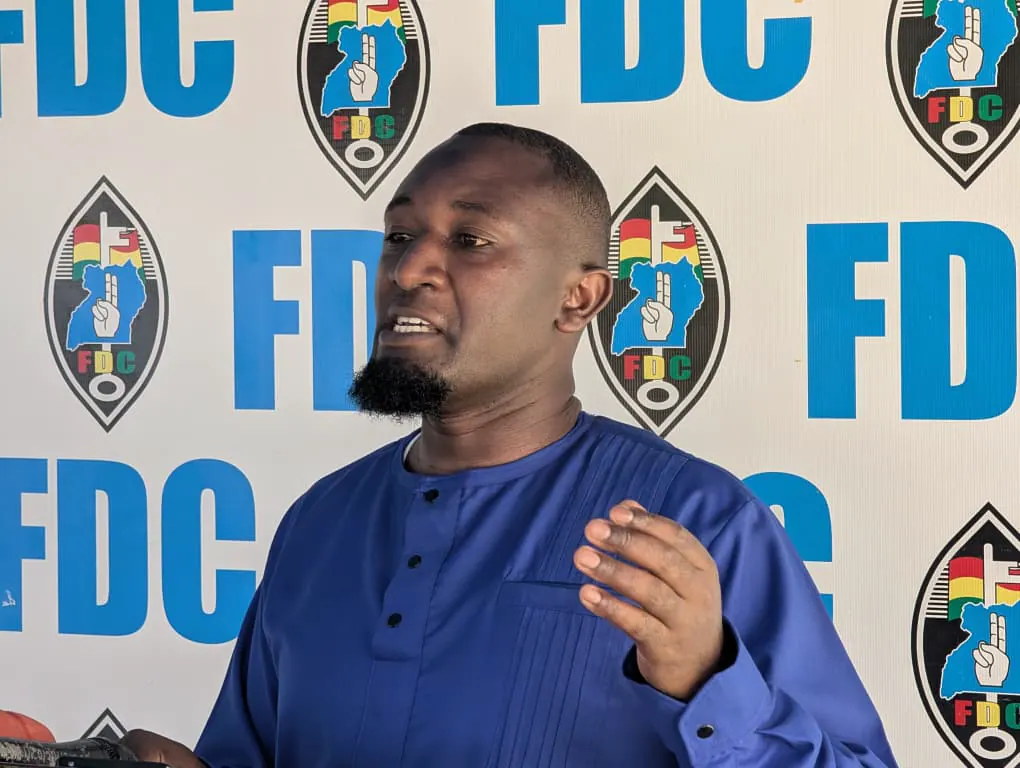
The Forum for Democratic Change (FDC) party in Uganda has accused the government of applying laws governing public assemblies selectively, citing a recent demonstration by the Patriotic League of Uganda (PLU) as evidence. According to FDC Deputy Secretary for Publicity, Publication and Documentation Mulindwa Walid Lubega, the September 18 PLU march to the Turkish Embassy in Kampala demonstrated double standards in law enforcement. The PLU supporters marched from Lugogo Cricket Oval to the Turkish Embassy in Kololo, demanding that Turkey hand over Ugandan political activist Fred Lumbuye to face criminal charges in Uganda.
Lubega contrasted the PLU demonstration with the treatment of protests organised by opposition parties, including the FDC. He argued that Article 29 of the Constitution guarantees citizens the right to freedom of assembly and peaceful demonstration. Lubega stated that the right to demonstrate has become a monopoly enjoyed by those affiliated with the ruling party and their PLU allies. He accused security agencies of responding to opposition demonstrations with arrests, beatings, and tear gas, while allowing ruling-party-aligned groups to demonstrate freely.
The FDC also criticised the ongoing anti-corruption operations led by Local Government Minister Balaam Barugahara. Lubega described these operations as insufficient to address systemic corruption. Barugahara has been conducting nationwide inspections under the “Expose the Corrupt in Local Government” campaign, during which officials in several districts have been arrested or subjected to investigations over alleged corruption, abuse of office, and mismanagement of public resources. Recent arrests have taken place in Tororo, Manafwa, and Sironko.
Lubega questioned the outcome of such arrests and argued that the government should focus on implementing recommendations contained in reports by the Auditor General, Inspectorate of Government, and parliamentary accountability committees. He cited concerns over the implementation of recommendations from accountability institutions, arguing that failure to act on such reports undermines efforts to combat corruption. The FDC called for greater enforcement of recommendations from the Auditor General, Inspectorate of Government, Public Accounts Committee, COSASE, and other parliamentary accountability committees.
The FDC further criticised the use of public rallies and media coverage during anti-corruption operations, arguing that investigations and prosecutions should be handled by legally mandated institutions. Lubega also raised concerns about the handling of accountability issues surrounding the Lubowa Specialised Hospital project, alleging that the government has restricted parliamentary scrutiny of the project. These claims were not independently established.
The FDC also criticised the use of serious criminal charges, including treason and firearms-related offences, in cases involving political opponents. Lubega cited the ongoing treason trial involving former FDC presidential candidate Dr Kizza Besigye and his co-accused. The party expressed concern about the circumstances surrounding their arrest and the evidence being presented in court. Recent testimony by prosecution witness Andrew Wilson, also known as Orlando, has been part of the ongoing court case.
The FDC called for a review of political cases involving treason, firearms, and alleged military equipment, as well as respect for the jurisdiction of civilian courts and the right to a fair and timely trial. Lubega stated that the party is not seeking to shield anyone accused of a crime but insisted that the state must prove criminal allegations through independent courts. The FDC demands equal protection of the law for all Ugandans and an end to the use of criminal prosecution as a substitute for political competition.
Key points
- FDC accuses government of selective law enforcement on political demonstrations
- FDC criticises anti-corruption operations as insufficient
- FDC calls for equal protection of the law for all Ugandans