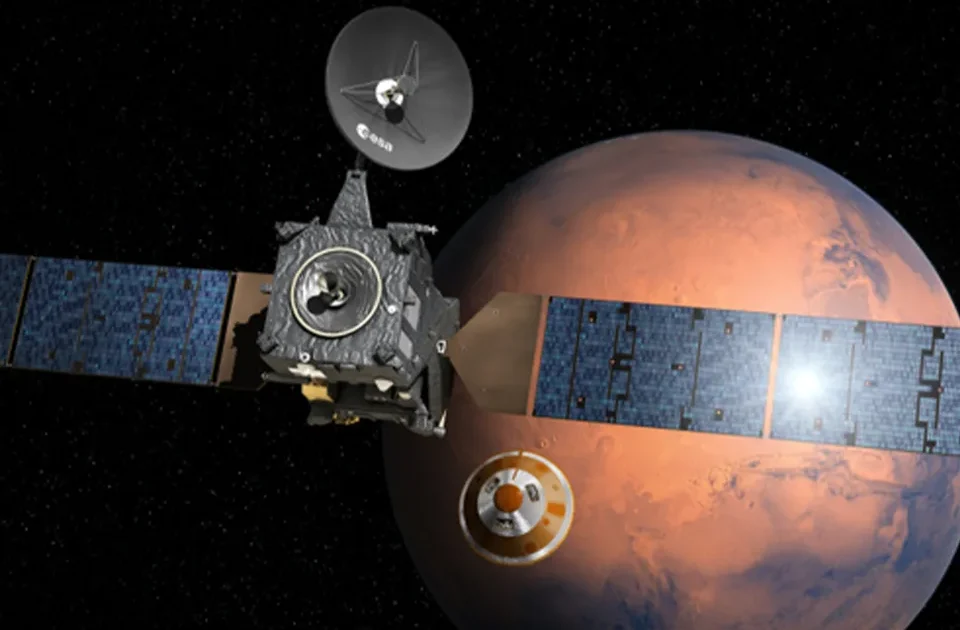
A UK-backed Mars rover, named Rosalind Franklin, is scheduled to launch in late 2028 and land on Mars in 2030 as part of the European Space Agency’s ExoMars programme. The ExoMars mission aims to answer one of humanity's most compelling questions: has life ever existed beyond Earth? The programme consists of two missions working together to study Mars from orbit and, in the near future, from the planet’s surface.
The Rosalind Franklin rover will search Mars’ surface for evidence of environments that may once have supported life and “may even still do so today.” The rover will have the unique feature of being able to drill down to two metres into the Martian surface to obtain samples. Samples taken from below the surface are better protected from the harsh radiation that affects the surface soil.
The samples will be analysed by an onboard laboratory to determine their mineral and chemical content and composition and search for evidence of past or present life. The mission will land in the Oxia Planum region of Mars, which contains ancient, clay-rich rocks dating back around 3.9 billion years. Clay minerals usually form in the presence of water, so this landing site gives scientists a promising place to look for evidence that Mars may once have had conditions suitable for life.
The rover is named after Rosalind Franklin, the UK scientist whose work was central to understanding the structure of DNA. The name connects the mission’s search for life on Mars with a scientist whose discoveries transformed our understanding of life on Earth. The UK Space Agency said the UK had invested around £490m over the past 20 years in the programme, supporting more than 200 high-skilled jobs.
The UK is also involved in the development of several scientific instruments on the rover. The PanCam panoramic camera system is UK-led, with scientists from University College London’s Mullard Space Science Laboratory working with the University of Aberystwyth, Birkbeck College and the University of Leicester. The University of Leicester, Bradford University and the Science and Technology Facilities Council’s Rutherford Appleton Laboratory are key partners in developing the Raman Laser Spectrometer.
The Trace Gas Orbiter, which started orbiting Mars in 2016 and began science operations in 2018, continues to study the planet’s atmosphere. It has relayed more data than all other Mars orbiters combined, including 13 million square kilometres of multispectral imagery. The orbiter uses four scientific instruments to detect and analyse trace gases, particularly looking for methane, which could be linked to both biological and geological processes.
NASA and SpaceX are also involved in the mission, with NASA approving the Rosalind Franklin Support and Augmentation project in early 2026, which will provide hardware and services for the mission. SpaceX’s Falcon Heavy rocket will launch the rover from Kennedy Space Center. The orbiter’s CASSIS camera produces high-resolution imagery of the planet to help prepare for future landings, including the Rosalind Franklin mission, and has made several discoveries, including detecting hydrogen chloride in Mars’ atmosphere and discovering water-ice at low latitudes.
Key points
- The Rosalind Franklin rover will drill up to two metres beneath the Martian surface to search for evidence of past or present life.
- The UK has invested around £490m in the ExoMars programme over the past 20 years.
- The Trace Gas Orbiter has relayed more data than all other Mars orbiters combined.