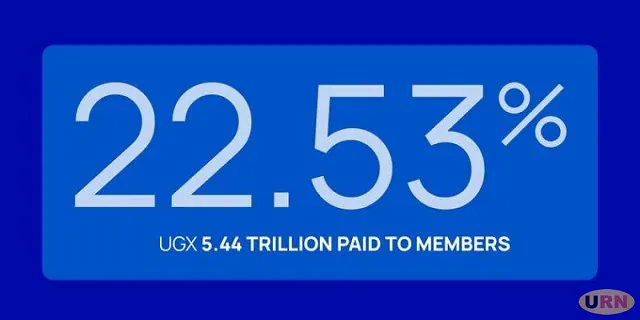
The National Social Security Fund (NSSF) in Uganda has announced that its members will earn a record 22.53 percent interest on their savings for the financial year 2025/2026. This translates to 5.44 trillion shillings in interest for its members. The unusually high return has raised questions about its potential impact on the country's wider savings and investment industry, particularly unit trusts, voluntary retirement schemes, and government securities.
The 22.53 percent rate is significantly higher than the returns currently offered by many competing savings and investment products in Uganda. Some savers have expressed excitement about the announcement, while others are reconsidering where to put their money. Kristian, a saver with MTN, said he had been considering moving some of his savings into NSSF's SmartLife Flexi voluntary savings product, but the 22.53 percent declared on the main fund has changed his calculations.
The announcement has created a challenge for savings products competing for Ugandans' money. Unit trusts have attracted savers partly because they provide relatively competitive returns while allowing investors easier access to their money. However, with returns of about 11 to 13 percent, they are now at a disadvantage compared to NSSF's 22.53 percent payout. Gerald Kasaato, the NSSF Deputy Managing Director, cautioned savers against making investment decisions based solely on the return declared in a single year.
Kasaato advised savers to diversify their investments by spreading their money between short-term products such as unit trusts and longer-term retirement savings. Managing Director Patrick Ayota similarly cautioned against concentrating savings in one investment product, citing the importance of diversification in managing investment risk. The 22.53 percent return is based on a year in which NSSF's overall financial performance was exceptionally strong.
The Fund's assets under management increased from about 26 trillion shillings to 32 trillion shillings, while annual revenue rose by 86 percent to 6.51 trillion shillings. Member contributions increased by 13 percent to 3.4 trillion shillings. The question for the market is whether such a return can be sustained by NSSF and what happens to savers' expectations if it cannot.
Bernard Oundo, former president of the Uganda Law Society, describes the development as a potential market disruptor. He believes that if NSSF can sustain returns at this level, it could significantly reshape Uganda's savings and investment landscape. Unit trusts, government bonds, and other savings products will face greater pressure to compete for investors' money.
The announcement has established a new reference point for savers, even though the products are not directly comparable in terms of liquidity, risk, investment horizon, or how returns are determined. Alex Kakande, a Certified Financial Analyst, predicts that NSSF has now created a very high benchmark for its own future performance and that the pressure will be real for fund managers and savers to watch.
Key points
- The unusually high interest rate may disrupt Uganda's savings and investment industry.
- Savers are being advised to diversify their investments to manage risk.
- The sustainability of the high return and its impact on savers' expectations remain to be seen.