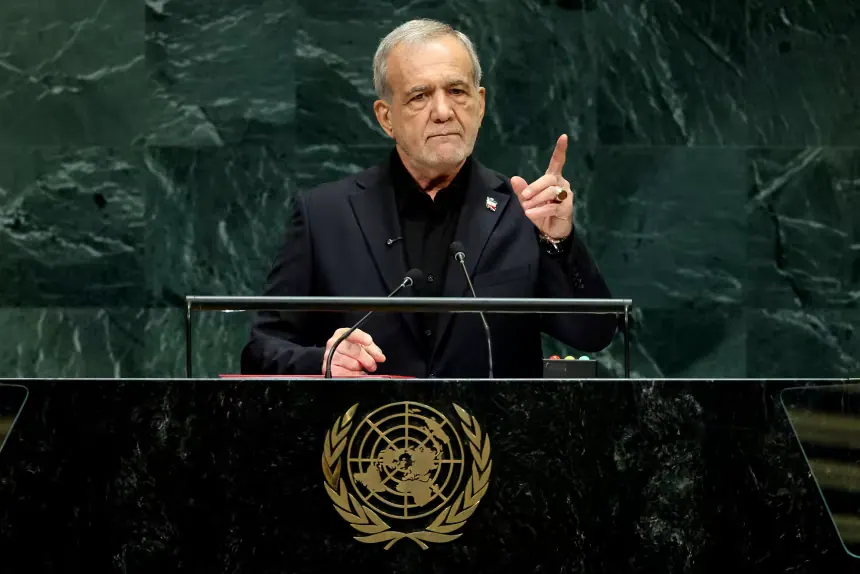
Seven months after a US-coordinated Israeli airstrike killed Supreme Leader Ayatollah Ali Khamenei, Iran's top diplomat, Abbas Araghchi, walked the streets of Manhattan under US Secret Service protection. As leaders gathered for the UN General Assembly, Araghchi and President Masoud Pezeshkian seized the opportunity to make their case to the world. They cast Iran as a country abiding by international law against "bullies" who are not.
Araghchi met with over two dozen diplomats, including counterparts from more than ten European countries and Jordan's foreign minister. He also held a rare direct meeting with US envoy Steve Witkoff and told western media that Iran had put a new offer on the table. In his address to the UN gathering, Pezeshkian said the Islamic Republic would never "bow down" – a line that resonated with hardliners at home.
Hardliners in Iran initially criticized Pezeshkian and Araghchi's diplomatic overtures to Washington. They saw the decision to visit the US as a sign of surrender. Araghchi came under fire from Iran's conservative lawmakers for meeting Witkoff. However, Iranian officials staged a visit that played well at home, revived a diplomatic track with their adversary, and declared a message of survival to the world.
Pezeshkian declared Iran's demands from the UN podium and held bilateral meetings with his counterparts. By contrast, Israeli Prime Minister Benjamin Netanyahu was met with protests on the streets of New York and a mass walkout of UN delegates as he delivered his speech. Araghchi's meeting with Witkoff aimed to break three months of diplomatic deadlock.
Iran said it had presented a proposal to the US that would reopen the Strait of Hormuz in return for Washington lifting its economic blockade of Iran. The proposal requires Washington to meet a set of conditions within seven days, Araghchi told reporters. He declined to elaborate on those conditions but said they were "nothing more" than what was included in the Memorandum of Understanding.
The new proposal requires Washington to take the first steps, an expert told CNN. "The offer now is essentially the same bargain, but with a very different sequence," Sina Toossi, a senior fellow at the Center for International Policy, said. "The US takes concrete steps first, and only then does Iran ease its pressure over Hormuz."
The central message from Pezeshkian's New York trip is that Iran genuinely wants a deal, but it is no longer willing to strike a deal and de-escalate first and simply trust that Washington will follow through. Both sides are currently locked in a showdown over who can live with the status quo the longest. Iran is advertising a high pain threshold while Trump insists that he will not be hurt in the upcoming midterm elections.
Key points
- Iran's leaders are seeking a deal with the US that would lift economic sanctions in exchange for reopening the Strait of Hormuz.
- The new proposal requires Washington to take the first steps, including waiving sanctions on oil sales and lifting the naval blockade.
- Iran's diplomatic efforts at the UN General Assembly have been met with mixed reactions at home and abroad.