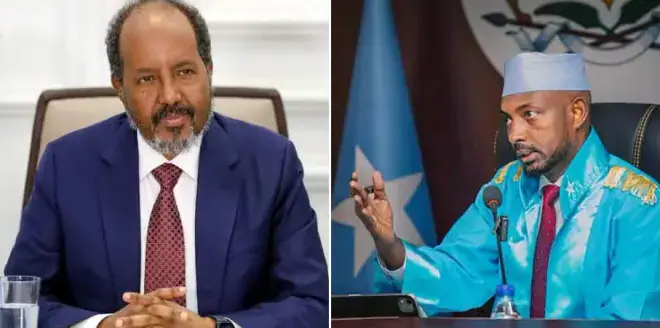
The Uganda Law Society has expressed concern over the confrontation between Somalia's presidency and judiciary, urging Somali President Hassan Sheikh Mohamud to respect Supreme Court rulings. In a statement, the professional association of Ugandan lawyers emphasized that Uganda's nearly two decades of military involvement in Somalia was intended to support lasting peace and democratic institutions. The society's statement, titled “Uganda Paid in Blood for Somalia's Peace. Mogadishu Must Not Waste It,” highlights the importance of respecting constitutional term limits, protecting judicial independence, and complying with the Supreme Court's decisions.
The Supreme Court of Somalia ruled on November 5 that constitutional amendments adopted in March 2026, extending presidential and parliamentary terms from four to five years, could not be applied to officials already holding office. The court determined that Hassan Sheikh's four-year mandate expired on May 15, 2026, and the mandates of both houses of the Federal Parliament ended on April 14. The court also directed political stakeholders to agree on an electoral framework within 30 days and hold elections within 90 days. However, the president's decision to dismiss Chief Justice Baashe on November 4 and appoint former Chief Justice Ibrahim Idle Suleiman as his replacement has deepened the dispute over the leadership of Somalia's highest court.
The Uganda Law Society criticized the president's actions, stating that the dismissal of Chief Justice Baashe was unconstitutional and null and void. The Supreme Court subsequently declared the dismissal unconstitutional, ruling that the president lacked authority to remove the chief justice without following established constitutional procedures. Despite the ruling, Hassan Sheikh proceeded with Suleiman's swearing-in on November 7. The Ugandan lawyers argue that these developments are particularly concerning given Uganda's central role in restoring security in Somalia since 2007.
Uganda was the first country to deploy troops under the African Union Mission in Somalia (AMISOM) in March 2007. The Uganda Law Society emphasized that the sacrifices made by Ugandan soldiers were not only for the absence of war but for Somalia to rebuild a country founded on peace, dignity, democratic governance, and the rule of law. The association cited Somalia's membership in the East African Community, saying Articles 6(d) and 7(2) of the EAC Treaty require partner states to uphold democracy, accountability, good governance, human rights, and the rule of law.
The Uganda Law Society called on the East African Community, African Union, and international diplomatic community to engage Somalia's leadership and encourage compliance with constitutional and regional legal obligations. Chief Justice Baashe welcomed the statement, thanking the Uganda Law Society for supporting judicial independence during a critical moment for Somalia. Baashe said the intervention demonstrated that constitutional principles were a shared responsibility among African countries.
Baashe also acknowledged Uganda's military contribution to Somalia since 2007, saying the sacrifices of Ugandan soldiers should be honored through respect for democratic institutions. He thanked Ugandan legal professionals and Senior Counsel Abdinasir for supporting efforts to defend judicial independence. The intervention comes as Somalia faces a widening dispute over constitutional amendments, presidential authority, and the timetable for federal elections.
The federal government maintains that the amendments provide a legal basis for Hassan Sheikh to remain in office until May 2027 while preparing the country for direct elections. However, opposition groups and regional administrations have rejected the timetable, arguing that the electoral process lacks a broad political agreement. Hassan Sheikh has invited opposition groups and civil society representatives to consultations in Mogadishu in an effort to resolve the impasse. The Uganda Law Society urged regional and international partners to help ensure that Somalia's political disagreements are resolved through constitutional procedures and dialogue.
Key points
- The Uganda Law Society has urged Somali President Hassan Sheikh Mohamud to respect Supreme Court rulings rejecting the extension of his presidential mandate and the dismissal of Chief Justice Baashe Yusuf Ahmed.
- The Supreme Court of Somalia ruled that constitutional amendments adopted in March 2026 could not be applied to officials already holding office.
- The Uganda Law Society called on the East African Community, African Union, and international diplomatic community to engage Somalia's leadership and encourage compliance with constitutional and regional legal obligations.