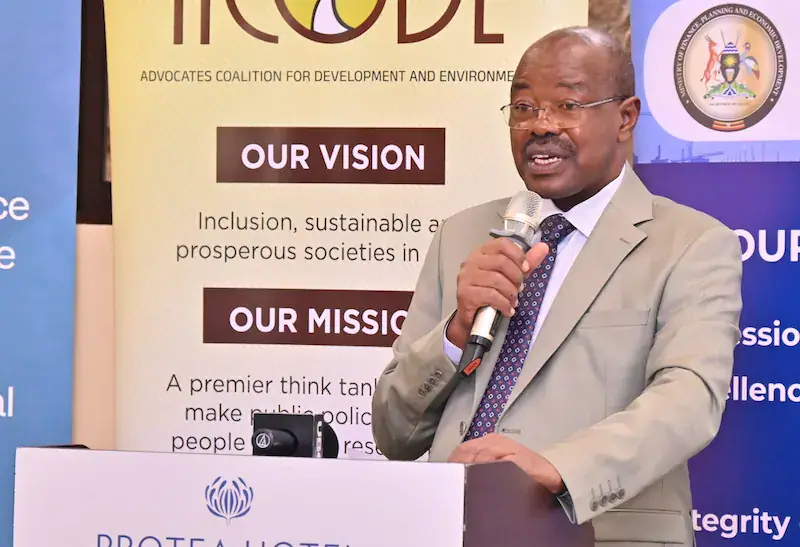
Uganda's Finance Minister Amos Lugoloobi has called for the reinstatement of professional statisticians in government agencies to improve data collection and inform public policies. He noted that the absence of dedicated statistical personnel could compromise the quality of information used in national planning, budgeting, and monitoring government programs. Lugoloobi emphasized the need for qualified statisticians to ensure accurate figures and prevent inappropriate policy decisions.
Lugoloobi made these remarks during the launch of the Fourth Plan for National Statistical Development (PNSD IV), the Uganda Bureau of Statistics (UBOS) Strategic Plan IV, and the bureau's Service Delivery Standards for 2025/26 to 2029/30. He highlighted Uganda's progress in statistical production, from struggling to obtain basic information for national planning to having increasingly available data. However, he noted that the country still faces challenges in translating available statistics into practical decisions.
The minister recalled that during the preparation of earlier National Development Plans (NDPs), the government faced significant information gaps across sectors. This made it difficult to establish baseline indicators and assess progress towards development targets. Some baseline indicators and targets were obtained from external sources, including the World Bank. Lugoloobi noted that the situation has since improved, with UBOS producing substantial statistical information relied upon by researchers, universities, and government institutions.
Lugoloobi emphasized that the current challenge is ensuring that available statistics are translated into practical decisions, particularly in budgeting, policy formulation, and monitoring public sector performance. He urged government institutions and public officials to base their reports and policy statements on verifiable evidence rather than generalizations. The minister cited claims about poverty, arguing that without supporting statistics, it is difficult to establish the extent of the problem or compare Uganda's performance with other countries.
The minister called for investment in modern statistical production systems, improved data integration across government institutions, and the adoption of emerging technologies, including artificial intelligence and big data analytics. He also emphasized the need for functional statistical units in ministries, departments, agencies, and local governments to improve data collection, monitoring, and evaluation. Strengthening the national statistical system is essential for monitoring the implementation of the Fourth National Development Plan (NDP IV) and measuring progress towards Uganda's economic expansion goals.
UBOS Executive Director Chris Mukiza described statistics as a strategic national asset, enabling the government to make informed decisions that improve citizens' lives. He noted that the bureau is committed to producing credible, timely, and relevant statistics aligned with national development priorities. Mukiza applauded the government for its continued support and called for stronger collaboration with development partners. He urged researchers, public institutions, and other data users to make greater use of official statistics and hold UBOS accountable to its service delivery standards.
The launch of the strategic documents is part of this year's Africa Statistics Week celebrations. The documents aim to improve the quality of official statistics and strengthen public service delivery. Lugoloobi urged UBOS to ensure full implementation of the documents, which operationalize the constitutional right of all Ugandan citizens to access high-quality, timely, and cost-effective public services.
Key points
- Reinstatement of professional statisticians in government agencies is crucial for accurate data collection and informed policy decisions.
- Uganda has made progress in statistical production but faces challenges in translating available statistics into practical decisions.
- Investment in modern statistical production systems and emerging technologies is necessary to improve data collection and integration.