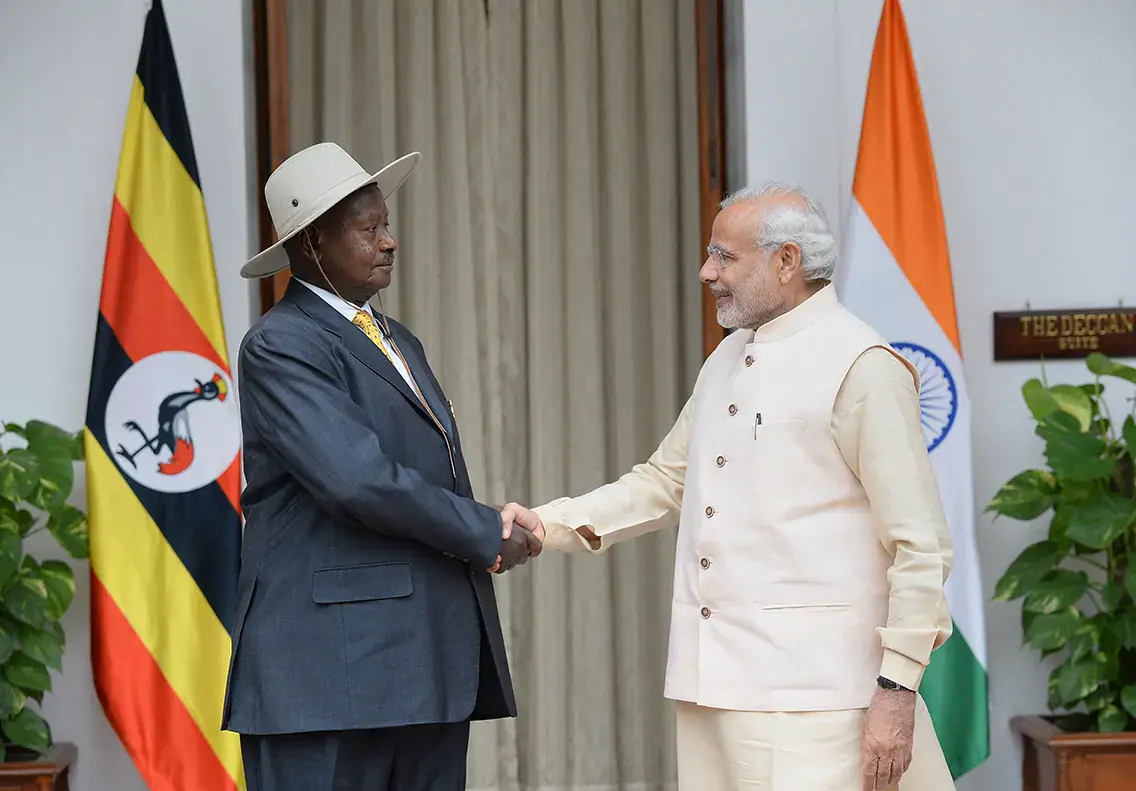
The Ugandan government is considering a proposal to recognize its Asian community as one of its indigenous tribes. If passed, this law would grant citizenship to around 27,000 Asians of mostly Indian origin who have lived in Uganda for centuries. This move comes as a surprise, given Uganda's history of expelling its Asian community in 1972 under Idi Amin's dictatorship. The proposal has gained momentum after President Yoweri Museveni hosted the Hindu festival of Diwali at State House in 2017.
The Asian community in Uganda has faced identity difficulties, particularly when applying for national identity cards and passports. Patel Sanjiv, the Indian Association leader in Uganda, had requested recognition as a native Ugandan tribe during the Diwali celebrations. This request was reiterated in subsequent years, including in 2021 and 2025. Parliament Speaker Jacob Oboth has expressed support for the proposal, stating that Asians have contributed significantly to Uganda's development and are represented in the country's political institutions.
The proposal to recognize the Asian community as indigenous has sparked debate about citizenship and identity in Uganda. Prof Mahmood Mamdani, a retired don from Makerere University, argues that the issue of citizenship is not just about the Asian community but also about the many minority groups in Uganda. He believes that Uganda should adopt a more inclusive approach to citizenship, rather than defining certain groups as non-indigenous.
The Asian presence in Uganda dates back to at least 1880, when traders from India arrived in the country. Many Indian workers were brought to Uganda by the British colonial government to work on the railway line from Mombasa to Uganda. After completing their contracts, many of these workers chose to remain in Uganda, establishing themselves in various professions such as trade, medicine, and education.
The expulsion of the Asian community in 1972 had severe economic consequences for Uganda. The sudden departure of over 50,000 Asians, who managed over 90% of Uganda's commerce and trade, led to the collapse of commercial and industrial networks. The government's tax revenue base was severely depleted, leading to hyperinflation and a reliance on external borrowing.
The economic reverberations of the 1972 expulsion persisted for many years, with estimates suggesting that it took until at least 1992 for the country to recover. However, the Asian community has shown determination to integrate with the majority indigenes and consider Uganda their home. The proposed recognition of the Asian community as indigenous could be a step towards healing the wounds of the past and promoting greater inclusivity in Uganda.
If the proposal becomes law, the Asian community will become the 57th officially recognized tribe in Uganda. This move follows Kenya's lead in 2017, when it designated its Asian population as the country's 44th tribe. The recognition of the Asian community as indigenous could have significant implications for Uganda's identity and citizenship laws, and could potentially pave the way for greater recognition of minority groups in the country.
Key points
- The proposal to recognize the Asian community as indigenous in Uganda has gained momentum after years of advocacy from the community.
- The Asian community in Uganda has faced significant challenges, including the 1972 expulsion, which had severe economic consequences for the country.
- The recognition of the Asian community as indigenous could promote greater inclusivity and recognition of minority groups in Uganda.